

The Taiwanese card payments market is set to grow at a compound annual growth rate (CAGR) of 7.9% between 2022 and 2026 to reach TWD4.8 trillion ($172.6 billion) in 2026, driven by a growing preference for electronic payments, a surge in contactless payments, and efforts by financial authorities to boost cashless payments, says GlobalData, a leading data and analytics company.
GlobalData’s report, ‘Taiwan Cards and Payments: Opportunities and Risks to 2026’, reveals that card payments value in Taiwan registered a growth of 4.5% in 2021, driven by improving economic conditions and a rise in consumer spending. This trend is expected to continue as card payments are estimated to register a growth of 6.2% to reach TWD3.5 trillion ($127.5 billion) in 2022.
Kartik Challa, Senior Banking and Payments Analyst at GlobalData, comments: “The Covid-19 pandemic and the economic uncertainty forced consumers to cut down on large-ticket spending including travel, which impacted card payments in 2020. As a result, card payments in Taiwan declined by 6.3% in 2020. However, economic recovery helped card payments rebound in 2021 and this is expected to continue in 2022.”
Taiwan’s payment card market is highly developed, with a card penetration of more than seven cards per individual. Debit cards dominate, with each individual holding more than five cards, while credit card penetration stands at over two cards per individual. Despite their lower penetration, credit cards are being widely used for payments by consumers in Taiwan, accounting for 92.2% of card payments by value in 2022, while debit cards occupy the remaining 7.8% share.
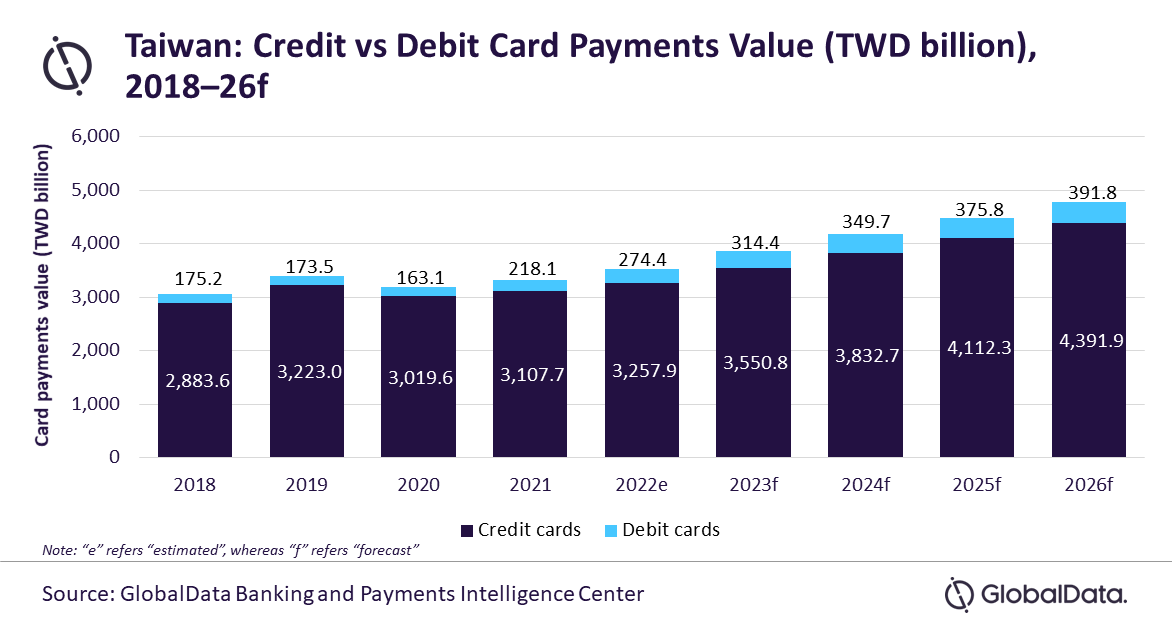
The frequency of credit card usage for payments stands at 45.0 times per card per year in 2022, which is expected to rise to 64.0 by 2026. On the other hand, debit card usage frequency is just 3.7 times per year. Reward benefits such as cashback, loyalty programs, discounts, and instalment facilities are some of the factors driving credit card usage.
Challa adds: “The number of credit cards in circulation in Taiwan is forecast to reach 65.6 million by 2026, increasing at a CAGR of 4.5%, while debit cards will grow at a CAGR of 4.2% to reach 139.8 million. The proliferation of digital-only banks is driving competition in the country’s banking space, thus helping boost debit card holding.”
However, credit card spending is expected to be impacted by rising borrowing costs, as the country’s central bank is on a rate hike path to control inflation. On December 16, 2022, it increased the key discount rate to 1.75%, up from 1.375% in March 2022, marking a fourth rate hike in the year.
Challa concludes: “A revival in the economy, reopening of businesses, and a rise in consumer spending benefitted credit card market last year. However, short term growth could be slower due to growing inflation and rising interest rates, which could impact credit card spend in the coming months.”
