

The Americas region is posing significant challenges for investors due to high inflation rates, high levels of debt, financial crises, and anti-government protests in recent times. Against the backdrop, the Americas region risk score increased from 46.9 in Q4 2021 to 47.5 in Q4 2022, indicating the second-highest level of risk among all the regions, reveals GlobalData, a leading data and analytics company.
In the 19th update version of GlobalData’s “Global Risk Report Quarterly Update – Q4 2022,” which evaluated 24 countries in the Americas region, two countries were classified as being in the very low-risk zone, two countries in the low-risk zone, 11 countries under manageable risk, seven countries under high risk, and two countries in the very high-risk zone.
Out of the 24 countries in the Americas region, Paraguay slipped by two places to 12th rank in Q4 2022 when compared with the previous update. Guatemala exhibited the swiftest improvement in ranking, indicating a steady economic recovery due to recovery in lagging sectors and strong remittances. On the contrary, the risk ranking of Brazil and Bolivia fell in Q4 2022 due to social conflict and political crisis.
Sadaf Ambari, Economic Research Analyst at GlobalData, comments: “The war between Russia and Ukraine pushed up the inflation rate in Americas’ largest economies in 2022. This was followed by the rise in the cost of borrowing to tame inflationary pressure. GlobalData projects the inflation rate in the Americas region to ease to 19.5% in 2023 from 21.5% in 2022 but stay much higher than the major American nations central bank’s target range. On the other hand, slowdown in global economy is expected to impact trade prospects and constraint economic growth of the region.”
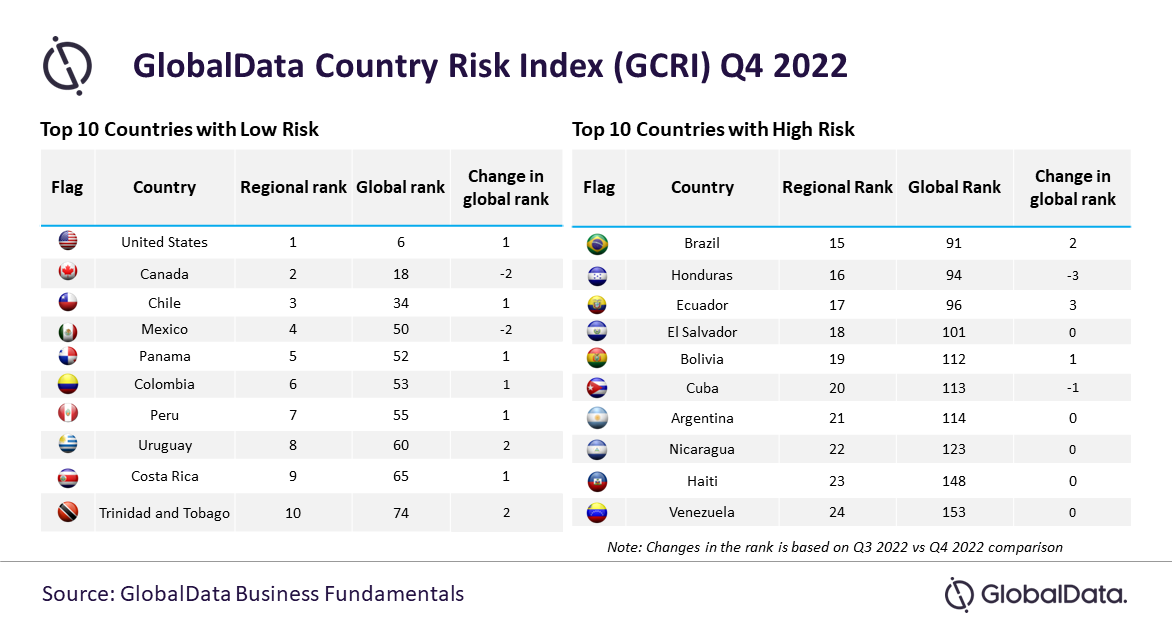
GlobalData highlights that US is in the list of the top 15 lowest-risk countries worldwide. However, Venezuela and Haiti are under the top 15 highest-risk countries.
In terms of political risk, anti-government protests erupted in Peru in December 2022 triggered by the eviction and arrest of the former leftist president and in Argentina, the government was asked to execute more work to improve social aid, as the country struggled with deep economic crisis and high inflation.
In terms of economic risk, weaker external demand, high interest rate and a higher dollar value will create challenges for economic growth prospects in 2023. In North America, real GDP in the US and Canada are projected to grow by 1.1% and 0.5%, respectively, in 2023, slower than the 2.1% and 3.5% growth recorded in the previous year, according to GlobalData estimates.
In Latin America, Brazil, Argentina, Chile, and Mexico are expected to grow at a slower pace of 0.8%, 0.0%, -0.7% and 1.2% in 2023 as compared to 3.0%, 5.1%, 2.5% and 3%, respectively, in 2022.
Ambari concludes: “Rising unemployment rates and high prices can reduce household disposable incomes and negatively impact private consumption. Additionally, factors such as increasing borrowing costs, low consumer and business confidence, political uncertainty, and subdued trade prospects keeps the risks for investors elevated in the region.”
