

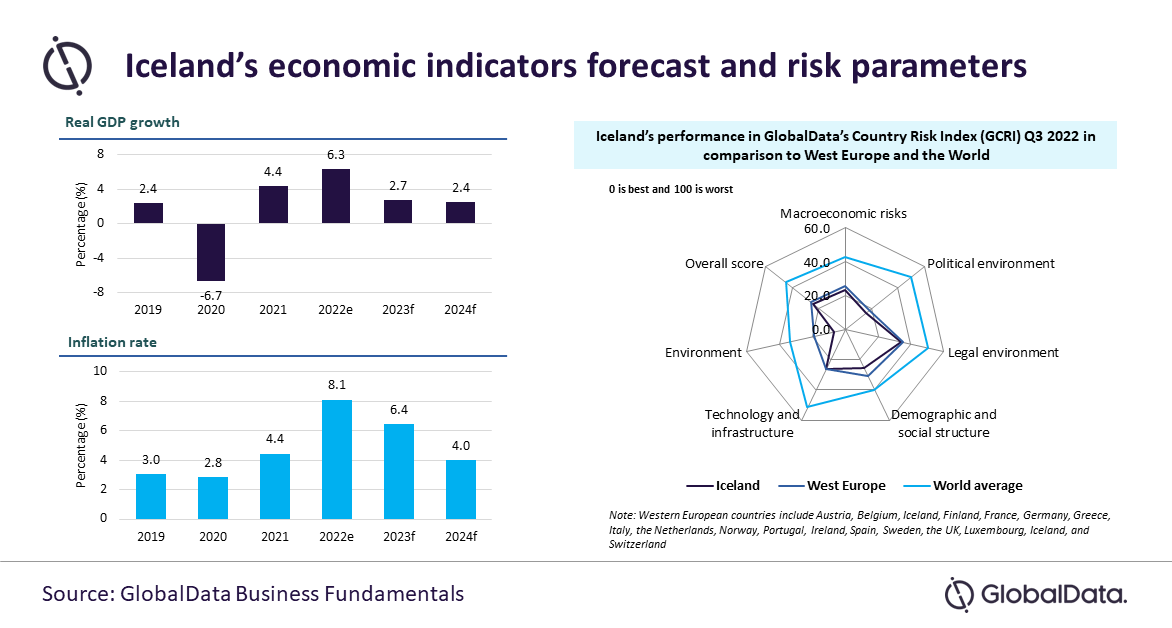
Higher prices, lower disposable income, and reduced demand from trading partners’ economies are expected to weigh on the economic activities in Iceland in the coming months. Against this backdrop, the Icelandic economy’s growth is forecast at 2.7% in 2023 slower compared to 6.3% growth in 2022, says GlobalData, a leading data and analytics company.
GlobalData’s latest report, “Macroeconomic Outlook Report: Iceland,” reveals that the country witnessed a solid economic recovery from negative growth of 6.7% in 2020 to 4.4% in 2021 and 6.3% in 2022. Recovery in tourism and increased exports of goods, especially those of aluminium and aquaculture products, were the main drivers of the recovery. Despite real earnings starting to decrease in the face of rising inflation, household consumption remained strong and registered 6% growth in 2022 to help achieve expansionary economic growth.
Maheshwari Bandari, Economic Research Analyst at GlobalData, comments: “Iceland’s economy is small and trade-dependent on only a few countries (five countries accounted for more than 60% of its exports in 2021). A slowdown or a recession in the trading partners’ economies, mainly in the UK and EU, in 2023 will directly impact the economic growth prospects of Iceland. Moreover, since the country’s monetary board began hiking interest rates in February 2022, amid ongoing inflationary pressures, there have been eleven rate hikes till February 2023. If financial circumstances deteriorate further and uncertainty over the effects of the crisis in Ukraine lingers, investment may suffer further.”
Financial intermediation, real estate, and business activities contributed 26.1% to the gross value added (GVA) of Iceland in 2022, followed by mining, manufacturing, and utilities with 14.4%, and wholesale, retail, and hotels with 11.2%. According to GlobalData, the three sectors are expected to grow by 7.3%, 5.5%, and 5.1%, respectively, in 2023, as compared to 12.9%, 9.7%, and 9.1% growth recorded in 2022.
According to the Statistics Iceland, inflation rate in the country was 9.9% in January 2023, the highest since September 2009. However, due to a tighter monetary policy rate and lower demand for goods and services amid an expected economic slowdown, the inflation rate in Iceland is projected to ease to 6.4% in 2023 from 8.1% in 2022, according to GlobalData.
Iceland is categorized as a low-risk nation and ranks 20th out of the 153 nations in GlobalData Country Risk Index (GCRI Q3 2022). The country’s risk score is lower in all the parameters including macroeconomic, political, legal, demographic, and social structure, technology and infrastructure and environmental risks when compared to the West Europe average.
Bandari concludes: “More than any other OECD nation, Iceland relies heavily on domestic renewable energy sources, with geothermal and hydro power meeting around 90% of its energy needs. Except for the fishing fleet and vehicles fuelled by oil, the nation is mostly protected from the effects of energy market instabilities. The government should keep promoting energy diversity to ensure energy security, particularly by encouraging investment in wind energy and by updating the laws governing energy production, transmission, and distribution.”
