

The Middle East and Africa (MEA) region has been severely affected by supply chain disruptions and the consequent rise in prices of essential commodities like food and fuel. This is due to the region’s heavy reliance on Russia and Ukraine for imports of staple food items. The region is also grappling with persistent challenges such as social unrest, food insecurity, and mounting debt. As a result, the region’s risk score has increased from 54 to 54.3 out of 100 in the Q4 2022 update, reveals GlobalData, a leading data and analytics company.
In the 19th update version of GlobalData’s “Global Risk Report Quarterly Update – Q4 2022,” which evaluated 56 countries in the MEA region, two countries were identified in the very low risk zone, four countries in the low-risk zone, 11 countries under manageable risk, 21 countries under high risk and 18 countries in the very high-risk zone in GCRI Q4 2022.
Bindi Patel, Economic Research Analyst at GlobalData, comments: “The decision by OPEC+ to cut oil production can impact the profitability of oil-producing nations in the MEA region, which rely heavily on oil exports to drive their economies. At the same time, many countries in the MEA region are heavily dependent on food imports, and disruptions to food supply chains due to factors such as conflict in Ukraine and Syria, drought in Horn of African nations* and Kenya continue to create significant challenges for food security.”
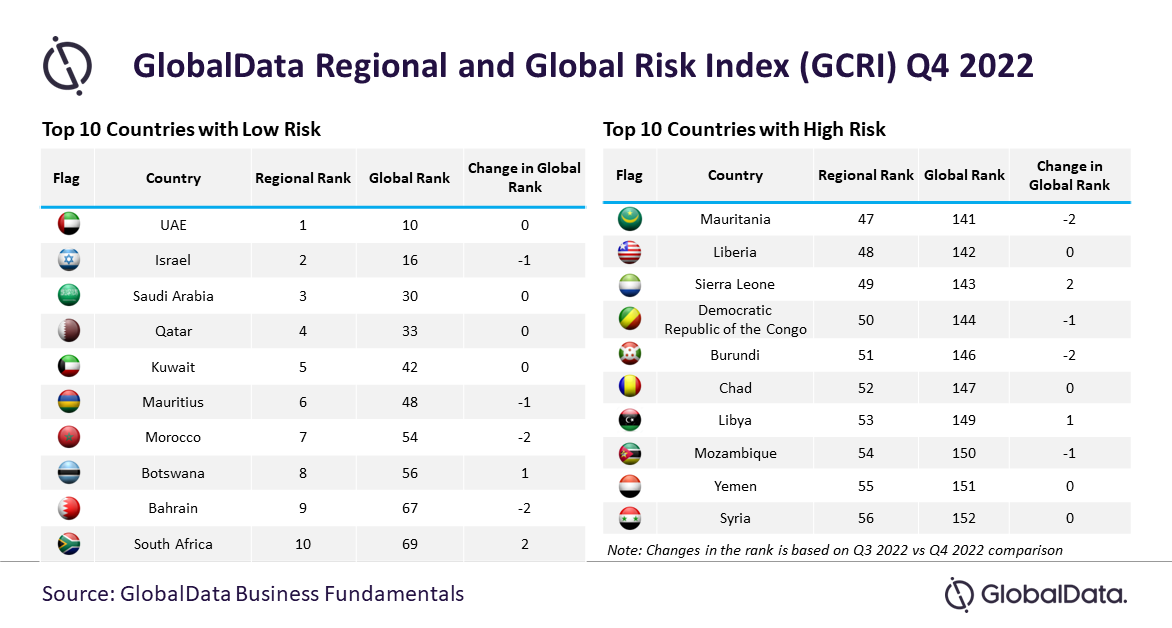
Out of 153 nations, Ethiopia, Madagascar, Mali, Guinea-Bissau, Angola, Mauritania, Liberia, Sierra Leone, Democratic Republic of the Congo, Burundi, Chad, Libya, Mozambique, Yemen, and Syria countries from the MEA region were in the list of top 15 highest risk nations in the GCRI Q4 2022 update.
According to United Nations Office for the Coordination of Humanitarian Affairs (OCHA), the number of hungry people in West and Central Africa was recorded at 35 million in 2022 and is projected to reach to 48 million by end of 2023. Around 32.5 million people in the Sahel** still experienced food insecurity as of 20 January 2023, the highest number recorded since 2016. It is estimated that over 37.8 million people in Sahel require assistance and protection in 2023.
Patel concludes: “Despite the implementation of tighter monetary policies, the inflation level in the MEA region is expected to remain alarmingly high, with only a marginal decrease projected. The inflation rate in the region is estimated to be 18.7% in 2023, with particularly high rates anticipated in Egypt (23.3%), Iran (40.7%), Turkey (43.7%), and Nigeria (19.3%).
“The overall risk for the countries in the region is still upward, as further slowdown in the global economy, increasing tighter monetary conditions, overall geopolitical tensions, and rise in poverty and food insecurity continue to negatively weigh on the MEA economies.”
*Horn of Africa – Countries include Sudan, Eritrea, Ethiopia, Djibouti, and Somalia.
**Sahel – Countries include Burkina Faso, Cameroon, Chad, The Gambia, Guinea Mauritania, Mali, Niger, Nigeria, and Senegal.
