
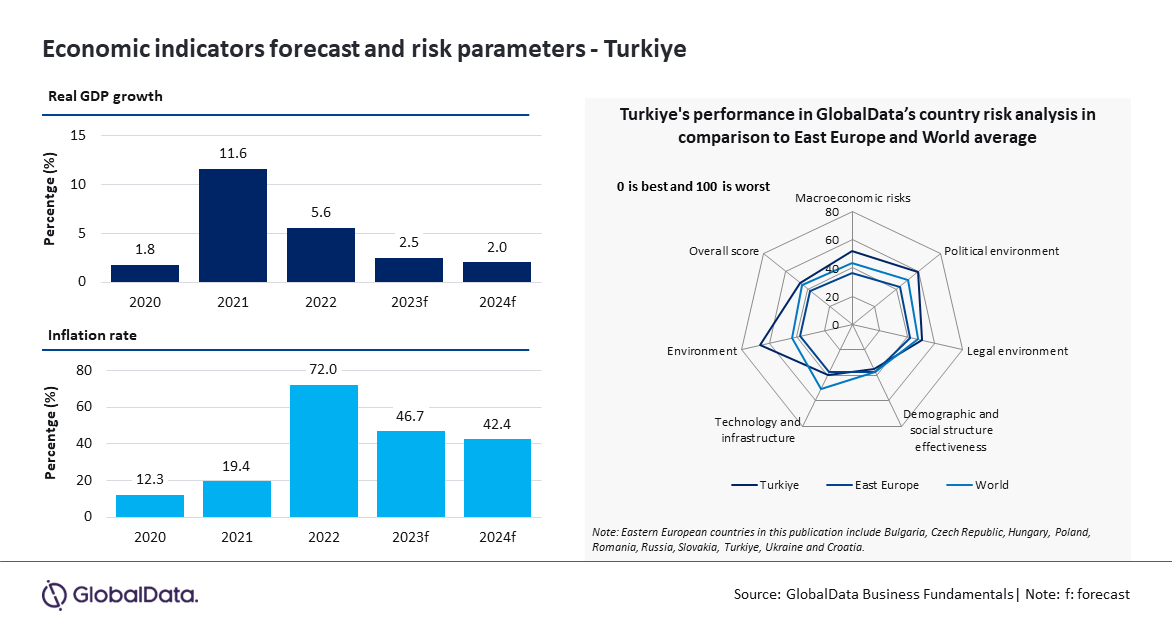
In February 2023, Turkiye experienced a catastrophic earthquake that resulted in over $100 billion in damages and claimed more than 50,000 lives, as per the United Nations estimates. This tragic event, coupled with soaring inflation rates, a depreciating currency, and reduced international demand, is anticipated to have substantial repercussions on Turkiye’s economic outlook. As a result, the country is forecast to see a deceleration in its economic growth, with a decline from 5.6% in 2022 to 2.5% in 2023, followed by a further decrease to 2% in 2024, according to GlobalData, a leading data and analytics firm.
GlobalData’s latest report, ‘Macroeconomic Outlook Report: Turkiye’ highlights the substantial impact of the devastating earthquakes that struck in February 2023 on production and supply chains in the country. In response to this crisis, Turkiye implemented various measures, including the removal of taxes to finance the reconstruction efforts following the earthquake.
According to data from the Turkish Statistical Institute, the country’s economy displayed signs of recovery in the second quarter of 2023, posting a quarterly growth rate of 3.5%. This rebound comes on the heels of a minor contraction of 0.1% in the previous quarter and stands as the most robust expansion observed since the third quarter of 2021. This noteworthy growth can be primarily attributed to the successful implementation of fiscal support measures and the impact of the May elections.
Puja Tiwari, Economic Research Analyst at GlobalData, comments: “Turkiye grapples with stubbornly high inflation, which reached 58.9% in August 2023, the highest since December 2022. Food inflation hit a concerning eight-month high of 72.9% during the same period. In contrast to other nations, Turkiye’s Central Bank continually reduced the policy rate until February 2023 but subsequently enacted three aggressive rate hikes to combat inflation. GlobalData projects a significant slowdown in real household consumption expenditure growth due to inflation, from 19.6% in 2022 to 2% in 2023.”
Sector-wise, mining, manufacturing, and utilities activities contributed 30.2% towards gross-value-added (GVA), followed by wholesale, retail, and hotel activities (26.7%), and financial intermediation, real estate, and business activities (12.6%) in 2022. The three sectors are forecast to grow by 50.9%, 47.1%, and 48.8% in 2023, respectively, compared to a growth rate of 115.1%, 162.7%, and 84.8% recorded in 2022.
Turkey plans rapid post-earthquake reconstruction, with thousands of homes and infrastructure projects to boost the construction sector. GlobalData predicts a robust 38.1% growth in construction GVA from 2023 to 2025.
In the first half of 2023, foreign tourist arrivals in Turkiye saw a significant annual growth of 19.9%, reaching nearly 19.6 million visitors, as reported by the Culture and Tourism Ministry of Turkiye. This increase was primarily driven by tourists from Europe, with Germany and the UK leading the way, along with a notable influx of Russian tourists due to flight restrictions imposed by Western nations in response to the Ukraine crisis. Looking ahead, GlobalData anticipates that international tourist arrivals in Turkiye will continue to rise, with a forecasted increase to 50.5 million in 2023, compared to 43.7 million in 2022.
Turkiye is categorized as one of the manageable risk nations and ranked 78th out of 153 nations in GlobalData Country Risk Index (GCRI Q1 2023). The country’s risk score is higher in the macroeconomic, political, legal, technology, infrastructure and environment parameters when compared to the average of the East European nations in Q1 2023.
Tiwari concludes: “Turkiye is steadfastly dedicated to navigating its economic challenges with determination and well-planned approaches. Emphasizing the significance of cooperation across various sectors, Turkiye is actively working to manage the anticipated economic deceleration effectively. As part of these efforts, the World Bank is poised to offer Turkiye $35 billion over the coming three years, further bolstering initiatives aimed at establishing a robust basis for long-term economic growth.”
