

Lifting of all domestic and border-entry COVID-19 restrictions will stimulate the sales of ice creams in Japan. However, sporadic Omicron virus outbreaks will continue to disrupt the out-of-home consumption of frozen desserts in the immediate future. Against this backdrop, the Japanese ice cream market is projected to expand to JPY620.1 billion ($6.4 billion) in 2026, registering a moderate compound annual growth rate (CAGR) of 1.8% over 2021-2026, says GlobalData, a leading data and analytics company.
GlobalData’s report, “Japan Ice Cream – Market Assessment and Forecasts to 2026,” reveals that the take-home and bulk ice cream category is set to register the fastest value CAGR of 2.5% over 2021-26, followed by the impulse ice cream category.
Bobby Verghese, Consumer Analyst at GlobalData, comments: “The Delta and Omicron outbreaks and the subsequent lockdowns and border restrictions have deeply impacted the consumer behavior in Japan. As most consumers continued to work, study, or cocoon at home, they sought indulgent treats to entertain themselves and alleviate the stress of social isolation. Manufacturers rolled out new product formats and flavors to address this demand for novel consumption experiences.
“As consumers stocked up their freezer shelves with frozen desserts for any time consumption, it spurred the sales of bulk packs and multipacks for at-home consumption. This gave rise to new at-home consumption occasions, thereby cushioning the decline in out-of-home consumption.”
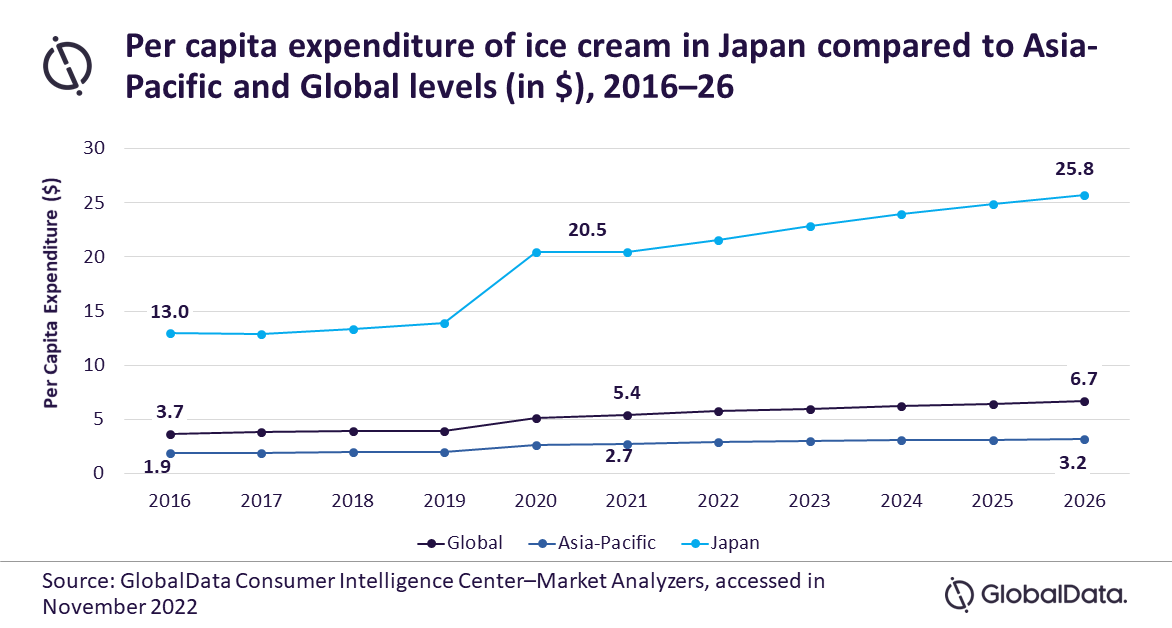
Consequently, the per capita expenditure (PCE) on ice cream in Japan increased from $13 in 2016 to $20.5 in 2021, surpassing the regional average of $2.7, and the global average of $5.4. The PCE on ice cream will surge to $25.8 in 2026.
Hypermarkets & supermarkets was the leading distribution channel in the Japanese ice cream market in 2021, followed by food & drinks specialists, and convenience stores. In value terms, Lotte, Ezaki Glico, and Morinaga & Co. were the top three companies in 2021 while Glico and Haagen-Dazs were the leading brands.
Verghese concludes: “The Japanese authorities rolled back most domestic COVID-19 restrictions by March 2022 and eased more travel and tourism restrictions in early December 2022, thereby stimulating the recovery of on-premise and on-the-go consumption of ice creams. Manufacturers are expected to step up product innovation to accelerate sales. The new product development can take the form of seasonal and limited-edition launches inspired by local and international cuisine, or naturally healthy products with less sugar and fat and more natural ingredients.”
