
Oil and Gas Technology Trends Bundle Report Overview
The rapid evolution of technologies has the potential to improve corporate operations and add value to them. It is likely that over the next decade, these digital and technological innovations will affect the growth of the oil and gas industry. This will be a result of the changes that have already begun to show in the method of working within the industry. Data gathering and management, predictive maintenance, and supervising dangerous locations, among others are some of the applications of tech in the oil and gas sector.
As a part of this bundle, you will gain access to in-depth insights available in the following reports:
- Thematic Research: Electric Vehicles in Oil & Gas (2022)
- Thematic Research: Internet of Things in Oil & Gas (2021)
- Thematic Research: Predictive Maintenance in Oil & Gas
- Thematic Research: Quantum Computing in Oil & Gas
- Thematic Research: Robotics in Oil & Gas (2021)
- Thematic Research: Virtual Reality in Oil & Gas (2022)
Report 1: Electric Vehicles in Oil & Gas – Thematic Research
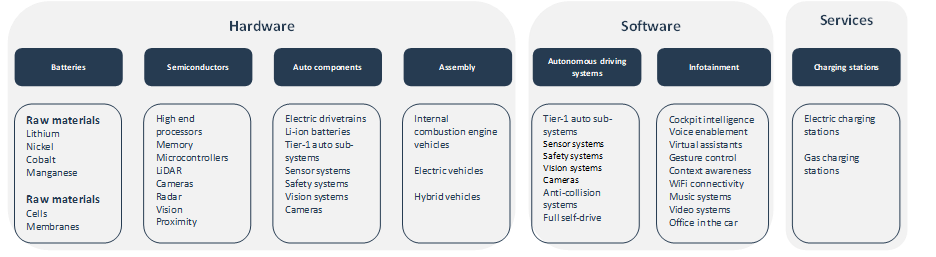
In response to Europe’s plans to phase out internal combustion engines (ICE) to support their climate goals, Europe-based oil and gas companies are pursuing the decarbonization of the transportation sector with zero-emission technologies. Oil majors such as Shell, BP, and TotalEnergies are aligning their businesses to facilitate the global transition from ICE to EV. The profits that they generate from core oil and gas operations will be used to finance their investment in clean energy technologies, including EV charging infrastructure. Initially, these companies began setting up charge points in key cities across Western Europe. Now they have expanded to the US and Asian countries, such as China, Singapore, and India.
Electric Vehicles Value Chain
To know more about EV in the oil and gas industry, download a free report sample
Report 2: Internet of Things in Oil & Gas – Thematic Research
The oil and gas industry is becoming a more enthusiastic adopter of digital technology as it struggles to cope with fluctuating oil prices, expanding sources of supply, and increasing regulatory requirements. Hence, IoT can help the sector collate and manage vast quantities of data to improve predictive maintenance, monitor emissions and the surrounding environment, and provide safer working conditions. Moreover, connected devices drive more sophisticated use of other technologies, namely artificial intelligence (AI), in the automation process. It creates a tech ecosystem that eases the difficulties of working in remote, dangerous conditions and working with aging, precarious assets through cross-functional collaboration.
IoT Value Chain

To know more about the IoT in the oil and gas industry, download a free report sample
Report 3: Predictive Maintenance in Oil & Gas – Thematic Research
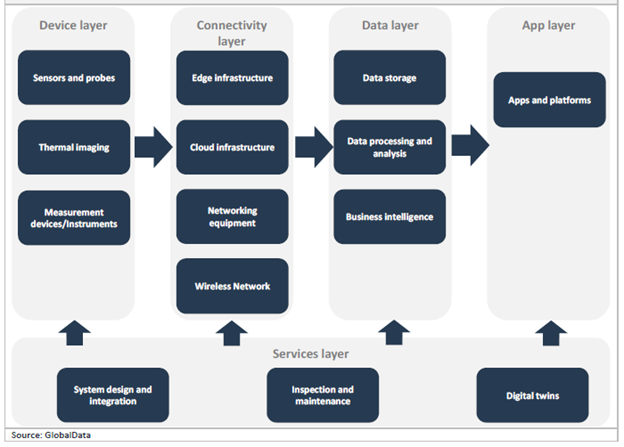
Predictive maintenance tools will become widespread across the critical infrastructure in the oil and gas industry, as they offer operational and financial fluidity through the use of technology. The emergence and rapid growth across innovative technologies have shaped the maintenance strategies in the oil and gas industry. Using predictive maintenance techniques, the performance of older equipment can be improved as well. Predictive maintenance includes condition monitoring technologies that collect, store, and analyze structural and operational data of key equipment in the industry to estimate its probable lifespan. This helps in scheduling maintenance and equipment replacement exercises to have a minimum impact on oil and gas operations.
Predictive Maintenance Value Chain
To know more about the predictive maintenance in the oil and gas industry, download a free report sample
Report 4: Quantum Computing in Oil & Gas – Thematic Research
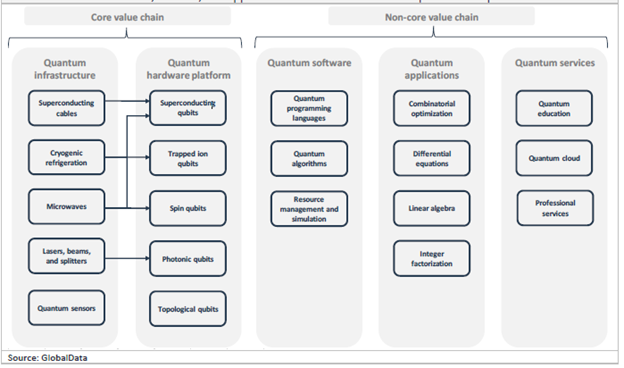
Oil majors are seeking to develop advanced materials for carbon capture technologies to potentially lower the operational costs of carbon capture and storage (CCS) projects. They are using quantum computing to solve diverse business problems. The upstream sector of the oil and gas industry has been a major beneficiary of supercomputers as they have helped companies to analyze vast volumes of seismic data for accurately detecting the presence and commercial viability of hydrocarbon deposits. Furthermore, researchers in oil and gas and its end-use sectors have started using quantum computing for molecular and material chemistry as this technology is far more capable of running complex calculations over classical computers.
Quantum Computing Value Chain
To know more about the quantum computing in the oil and gas industry, download a free report sample
Report 5: Robotics in Oil & Gas – Thematic Research
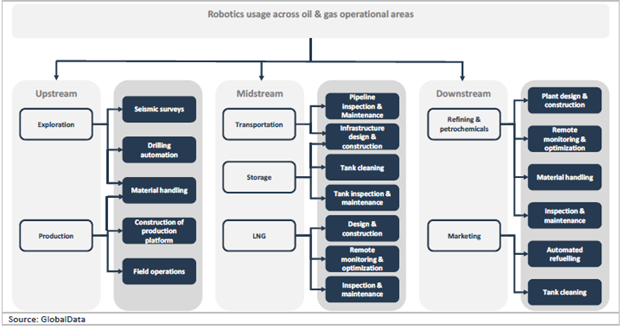
Robotics has been adopted in the construction of oil and gas facilities as well as for inspection and maintenance tasks. It also functions as terrestrial crawlers, quadrupeds, aerial drones, autonomous underwater vehicles (AUVs), and remotely operated vehicles (ROVs). The inclusion of other digital technologies, such as AI, cloud computing, and IoT, along with various sensors has improved the performance of robots for oil and gas applications. Furthermore, robots are being deployed to oversee the inspection of hazardous and difficult-to-access locations, thus preventing accidents that could cause delays. Several complex tasks, such as drilling, are being automated to reduce human error and accidents and the adoption of cleaning robots is on the rise for tank cleaning and other applications.
Robotics Usage Analysis
To know more about robotics in oil and gas industry, download a free report sample
Report 6: Virtual Reality in Oil & Gas – Thematic Research
Large oil and gas companies are using VR for training, collaboration, and data visualization. In training rooms, the trainee personnel is given VR headsets that are used to create the physical environment. This delivers an immersive experience of a facility, be it an offshore production platform, a gas processing plant, or a refinery. Moreover, VR will help in extracting the maximum value from digital twins. VR is also being used to increase the efficiency of inspection and certification of assets through remote data collection and modeling, thus integrating historical data with real-time information to ascertain the structural integrity of assets.
VR Value Chain

To know more about the VR in the oil and gas industry, download a free report sample







