Financial Inclusion – Thematic Intelligence
Powered by 
All the vital news, analysis, and commentary curated by our industry experts.

Financial Inclusion Thematic Report Overview
GlobalData defines financial inclusion as: “efforts to increase the accessibility, affordability, and applicability of financial services”. By identifying barriers and key sources of friction, providers can give customers more of what they want, more quickly (and cheaply) than before.
The ‘Financial Inclusion’ thematic intelligence report gives you an in-depth insight into the financial inclusion theme and the ways it will impact different financial services provider types and business models. It further entails a deep-dive analysis of the theme, including key market trends that will shape the financial inclusion theme over the coming years. The report also gives an insight into the market players and the competitive landscape within the theme.
| Report Pages | 54 |
| Regions Covered | Global |
| Key Trends | · Technology Trends
· Macroeconomic and Social Trends · Regulatory Trends |
| Value Chain | · Regulatory Entitlements/Bank Partner
· Core Banking · Middleware and Middle Office · Front-End Channels · Non-Banking Interfaces |
| Developing Economy Un/and Underbanked Fintech | · GXBank
· Khazna Tech · Klar · Kuda · Lucky Financial · Others |
| Developed Economy Un- and Underbanked Fintech | · Chime
· Current · Lydia · Majority · Monese · Others |
| Marginalized Segmented-Focused Fintech | · Atem
· BetaBank · Cheese · Comun · Daylight · Others |
| Conscious Community-Focused Fintech | · Aspiration
· Glorifi · Helios · Tomorrow · Wahed |
| Enquire & Decide | Discover the perfect solution for your business needs. Enquire now and let us help you make an informed decision before making a purchase. |
Financial Inclusion – Key Trends
The main trends that will shape the financial inclusion theme over the next 12 to 24 months are classified into technology, macroeconomic and social, and regulatory trends.
- Technology trends: The key technology trends impacting the financial inclusion theme are the proliferation of mobile users, big data credit scoring, growing automation across industries, and the rising use of artificial intelligence, and cloud-based applications.
- Macroeconomic and social trends: New entrants cynically deploying financial inclusion, COVID-19, rising interest rates, LGBT, and non-traditional income patterns are the key macroeconomic and social trends influencing the financial inclusion theme.
- Regulatory trends: Fee transparency, immigration policy, bank as a service, data privacy and consent management, and open banking are regulatory trends impacting the financial inclusion theme.
Buy the Full Report for More Trend Insights into the Financial Inclusion Theme
Financial Inclusion Value Chain Analysis
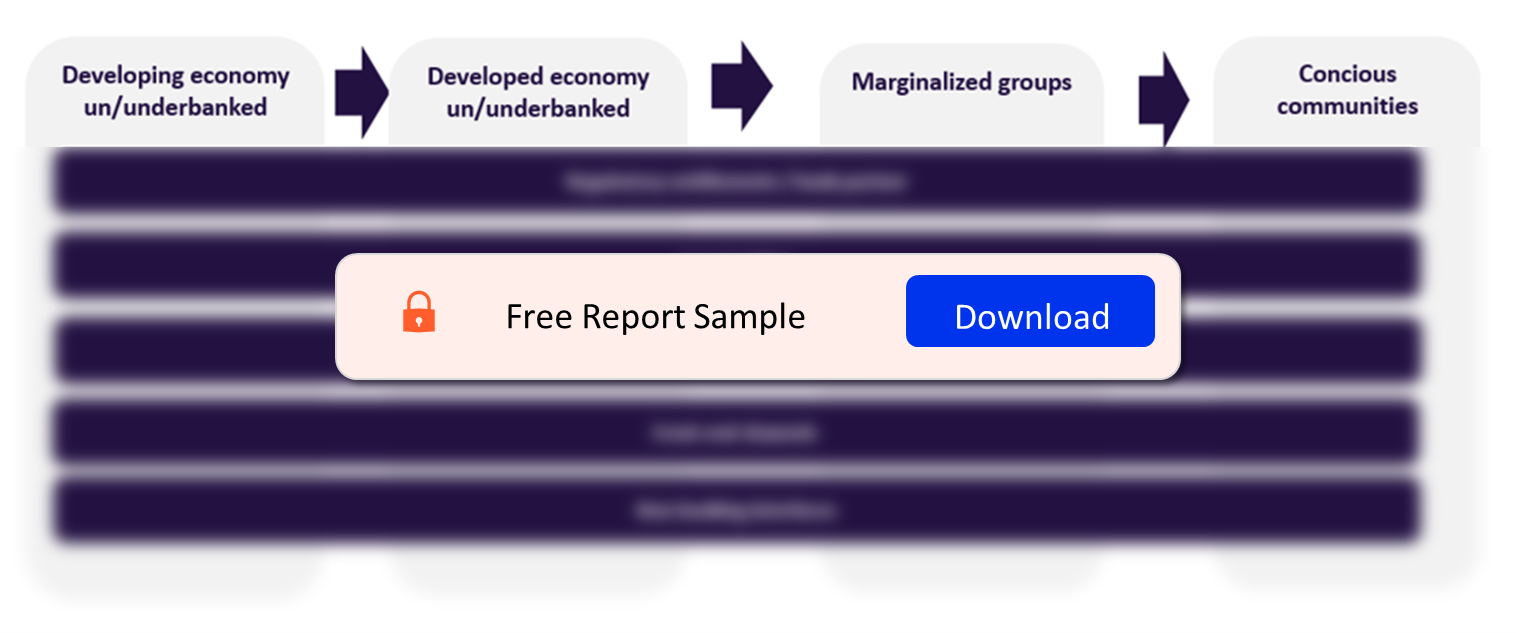
In 2024, financial inclusion initiatives tend to fall into four broad categories. First, the un- or underbanked individuals or often risky, rural, and micro enterprises categorized as developing economy un/underbanked. Second, the equivalent segment in developed markets, who are typically underbanked (rather than unbanked) due to credit scores, financial literacy, hidden fees, etc. termed as developed economy un/underbanked). Third, the marginalized segments, experience some degree of discrimination from mainstream providers due to their sexuality, ethnicity, political/religious beliefs, etc. Fourth, communities that can access financial services, but not in ways that strictly advance issues they care about most, are categorized as conscious communities.
Financial Inclusion Value Chain Analysis
Buy the Full Report for More Insights into the Financial Inclusion Value Chain
Download a Free Report Sample
Financial Inclusion – Competitive Landscape
Developing Economy Un/and Underbanked Fintech
A few leading most established or interesting players catering to un or underbanked in emerging markets are:
- GXBank
- Khazna Tech
- Klar
- Kuda
- Lucky Financial
- Others
Developed Economy Un- and Underbanked Fintech
A few of the most established or interesting players catering to un or underbanked in more developed markets are:
- Chime
- Current
- Lydia
- Majority
- Monese
- Others
Marginalized Segmented-Focused Fintech
The following are a few new digital banks or digital platforms primarily or exclusively focused on certain communities, whether along the lines of political or ethical care-about, racial or religious groups, and so on. They aim to combine profit, purpose, and a specific set of consumer needs.:
- Atem
- BetaBank
- Cheese
- Comun
- Daylight
- Others
Conscious Community-Focused Fintech
The following are a few new digital banks or digital platforms primarily or exclusively focused on certain communities, whether along the lines of political or ethical care-about, racial or religious groups, and so on. They aim to combine profit, purpose, and specific sets of consumer needs.
- Aspiration
- Glorifi
- Helios
- Tomorrow
- Wahed
Buy the Full Report to Know More about the Companies Making their Mark Within the Financial Inclusion Theme
Download a Free Report Sample
Banking Sector Scorecard
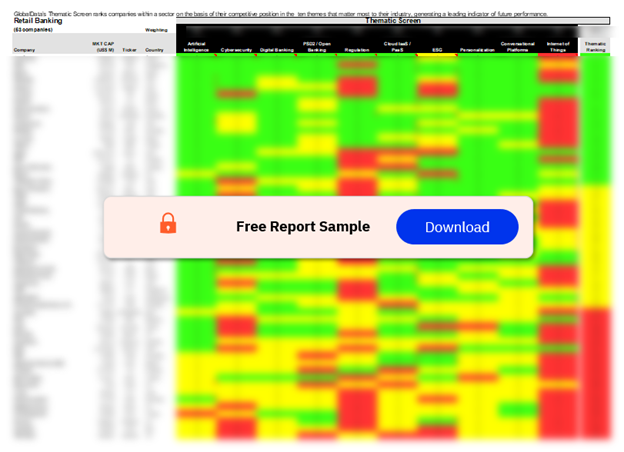
At GlobalData, we use a scorecard approach to predict tomorrow’s leading companies within each sector. Our sector scorecard has three screens: a thematic screen, a valuation screen, and a risk screen.
- The thematic screen ranks companies based on overall leadership in the 10 themes that matter most to their industry, generating a leading indicator of future performance.
- The valuation screen ranks our universe of companies within a sector based on selected valuation metrics.
- The risk screen ranks companies within a particular sector based on overall investment risk.
Banking Sector Scorecard – Thematic Screen
Buy the Full Report to Know More about the Sector Scorecards in the Financial Inclusion Theme
Download a Free Report Sample
Scope
The report includes:
- Many of the most successful new digital banks in the world are primarily about the economics of financial inclusion, whether that is Nubank in Brazil, WeBank and MYbank, in China, Digibank in India, Ualá in Argentina, and TymeBank in South Africa.
- Despite a much more difficult funding environment, significant investment dollars continue to flow into markets where mobile penetration is high but banked populations are low because many believe financial inclusion is big business.
- Many financial inclusion startups target key remittance corridors for target demographics, then expand out into additional financial services. GlobalData’s 2023 Financial Services Consumer Survey reveals that individuals who send money abroad to family or friends are almost four times as likely to have suffered from financial fraud compared to those who have not sent remittances.
- Alcohol consumption is one of the first focal points for changed behavior when consumers seek to pursue healthier lifestyles.
- Half of drinkers globally state they are often or always influenced in their product choice by how an alcoholic beverage impacts their health and well-being.
Reasons to Buy
- Identify the core components of meaningful financial inclusion around the accessibility, affordability, and applicability of financial services.
- Understand which technology trends are enabling a new breed of highly segmented, digital-first financial inclusion providers in both emerging markets and established economies.
- Understand the latest regulatory trends impacting financial inclusion, and where arbitrage opportunities may exist for new entrants versus incumbent banks.
- Understand what are the best attack vectors for financial inclusion in terms of product and experience, as well as which markets are most ripe for new entrants (based on growth forecasts, consumer openness, etc.).
- Review a firm-level insight into the best financial inclusion propositions worldwide..
Apple
Alphabet
Tinkoff Bank
AIB
Capital One
WeBank
MYbank
Monzo
NatWest/RBS
Danske Bank
DBS
TSB
BBVA
Citibank
mBank
Revolut
Credit Agricole
Barclays
CreditLadder
NovaCredit
Experian
Equifax
TransUnion
Tink
Bud
Plaid
TrueLayer
Cornami
Decentriq
Immuta
Inpher
Statice
Table of Contents
Frequently asked questions
-
What are the key components of the financial inclusion value chain?
The financial inclusion value chain is split into four segments, which can be considered stages of maturity, which allow consumers to move from being completely unbanked to underbanked to key sources of friction reduced, to dedicated “conscious” communities geared around consumers’ core beliefs and values.
-
What are the main trends shaping the financial inclusion theme?
The main trends that will shape the financial inclusion theme over the next 12 to 24 months are technology, macroeconomic and social, and regulatory trends.
-
Which are the most established or interesting players catering to un or underbanked in emerging markets?
A few of the most established or interesting players catering to un or underbanked in emerging markets are GXBank, Khazna Tech, Klar, Kuda, Lucky Financial, and others.

Get in touch to find out about multi-purchase discounts
reportstore@globaldata.com
Tel +44 20 7947 2745
Sample Report
Financial Inclusion – Thematic Intelligence was curated by the best experts in the industry and we are confident about its unique quality. However, we want you to make the most beneficial decision for your business, so we offer free sample pages to help you:
- Assess the relevance of the report
- Evaluate the quality of the report
- Justify the cost
Download your copy of the sample report and make an informed decision about whether the full report will provide you with the insights and information you need.


Related reports
View more Retail Banking and Lending reports