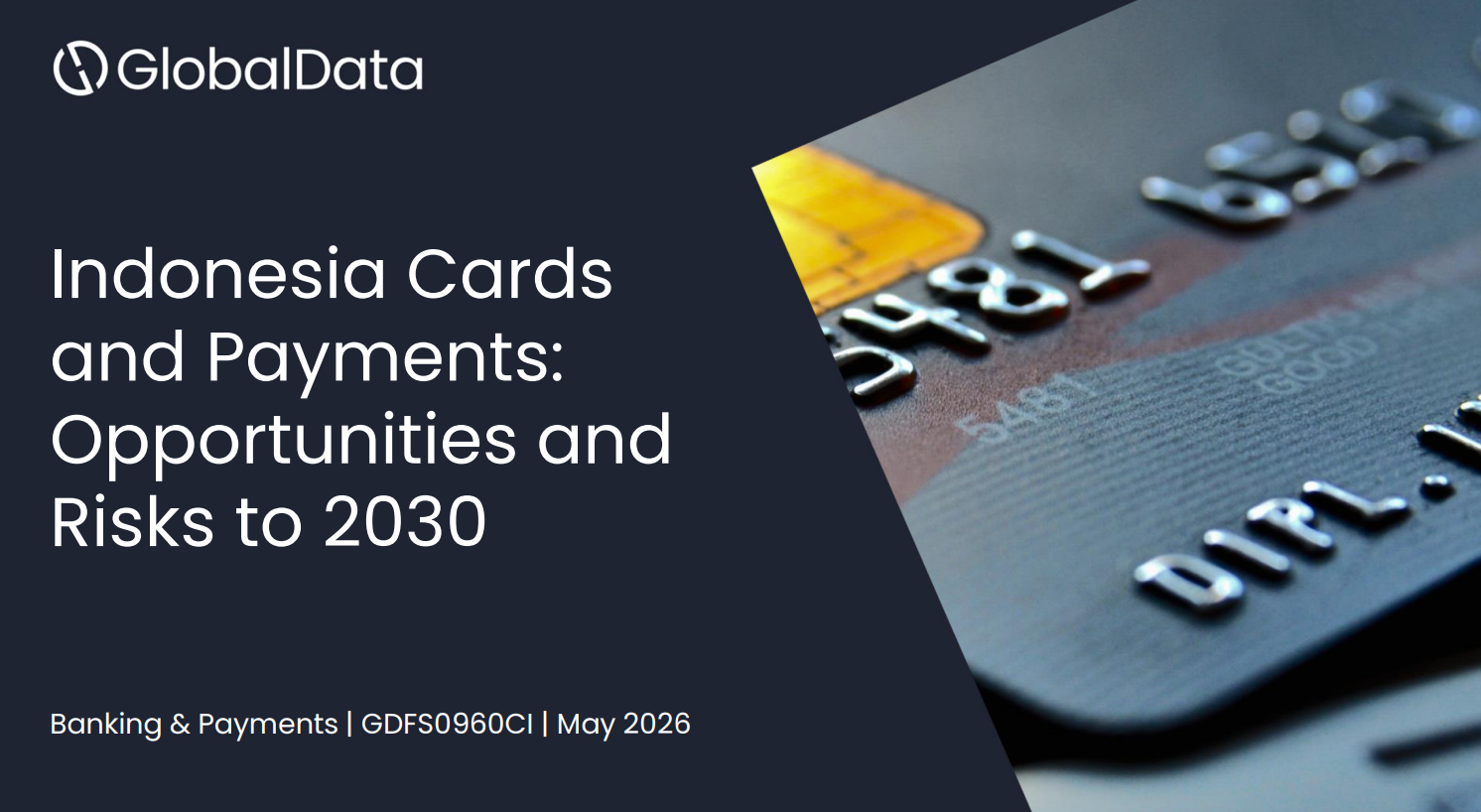
Indonesia Cards and Payments: Opportunities and Risks to 2030
Powered by 
All the vital news, analysis, and commentary curated by our industry experts.

Analyze Indonesia’s cards and payments market through 2030, including debit, credit and charge cards, payment trends, ecommerce, regulations, competitors, and consumer insights.
Why Does the Indonesia Cards and Payments Market Matter?
Indonesia’s cards and payments industry is evolving rapidly as digital banking, mobile-first consumer behavior, ecommerce, contactless payments, and cross-border payment initiatives reshape how consumers and businesses transact.
GlobalData’s Indonesia Cards and Payments: Opportunities and Risks to 2030 report provides a comprehensive analysis of the country’s payments landscape, combining historical and forecast market data with competitive analysis, consumer insights, regulatory developments, and payment technology trends.
The report covers debit, credit, and charge cards, as well as major payment instruments including cards, credit transfers, cash, cheques, and direct debits. It also examines alternative payment brands, ecommerce, payment regulations, and the strategies adopted by banks and other financial institutions.
With the review period covering 2022–2026 and forecasts extending through 2030f, the report helps banks, card issuers, payment providers, investors, and financial services companies identify growth opportunities and assess competitive risks in Indonesia.
Key Insights in the Indonesia Cards and Payments Market
The report highlights several developments shaping Indonesia’s payments ecosystem:
- Digital banking is gaining popularity, supported by regulatory initiatives and mobile-first consumer behavior
- Consumers are increasingly seeking convenient, integrated financial services
- Digital wallets are expanding their role beyond payments into broader financial services
- Cross-border payment connectivity is becoming a strategic priority
- Indonesia is participating in regional initiatives designed to strengthen instant payment interoperability
- Contactless payments are expanding across public transportation
- Ecommerce continues to influence payment preferences and transaction behavior
- Banks and card issuers are adapting their strategies to changing consumer expectations
- Alternative payment instruments are becoming increasingly important alongside traditional cards
- Regulatory developments are shaping innovation and competition across Indonesia’s payments market
Scope
What Will You Learn from This Indonesia Cards and Payments Market Report?
This report provides insight into:
- Indonesia cards and payments market size
- Debit, credit, and charge card markets
- Number of cards in circulation
- Card transaction values and volumes
- Historical market performance from 2022 to 2026e
- Market forecasts through 2030f
- Major payment instruments
- Ecommerce payment trends
- Alternative payment brands
- Consumer attitudes and card preferences
- Leading card issuers and payment schemes
- Competitive market shares
- Payment industry regulations
- Market drivers and growth opportunities
Banking and payment provider strategies
Target Buyers for This Indonesia Cards and Payments Market Report
This report may be valuable for:
- Banks
- Card issuers
- Payment service providers
- Digital banks
- Fintech companies
- Digital wallet providers
- Payment schemes
- Ecommerce companies
- Financial technology investors
- Strategy and corporate development teams
- Market intelligence professionals
- Financial services consultants
- Regulatory and compliance teams
How Companies Use This Indonesia Cards and Payments Market Analysis
Financial institutions and payment companies can use the report to understand market performance, identify growth opportunities, benchmark competitors, and develop strategies for Indonesia’s evolving payments ecosystem.
For example:
- Banks can assess card segment growth and changing consumer preferences
- Card issuers can benchmark market positioning and develop targeted card strategies
- Fintech companies can identify opportunities across digital payments and alternative payment instruments
- Payment providers can assess contactless, ecommerce, and cross-border payment opportunities
- Investors can evaluate market growth, competitive dynamics, and emerging payment opportunities
- Strategy teams can use forecasts and regulatory analysis to support long-term planning
- Ecommerce companies can better understand payment behavior and consumer preferences
Key Highlights
Digital banking is growing in popularity, underpinned by strong regulatory support, mobile-first consumer behavior, and rising demand for convenient, integrated solutions. In May 2025, the introduction of OVO Nabung by Superbank enabled users to open and manage a regulated savings account within the OVO wallet. This allows users to save directly via the OVO app without fees.
In February 2026, BI joined Project Nexus to strengthen cross-border payment networks by collaborating with five other central banks: Bank Negara Malaysia, Bangko Sentral ng Pilipinas, Monetary Authority of Singapore, Bank of Thailand, and the Reserve Bank of India. Project Nexus aims to connect various domestic instant payment systems to improve the speed, cost, transparency of, and access to cross-border payments. It is designed to standardize the way that global instant payment systems connect to each other.
Contactless payments are gaining traction, driven by their introduction within public transport networks. In June 2025, public transport operator PT Moda Integrasi Transportasi Jabodetabek and Visa introduced contactless payments at the station gates of the Soekarno-Hatta Airport Rail Link. This enables passengers to tap Visa contactless cards, mobile wallets, and smartwatches to buy tickets, removing the need for physical tickets or waiting in line at ticket machines.
Reasons to Buy
Benchmark Indonesia’s Payments Market Against Competitors
The report provides the market data and competitive intelligence needed to assess Indonesia’s position within the broader payments landscape.
It enables users to evaluate:
- Card market development
- Transaction value and volume
- Payment instrument trends
- Competitive positioning
- Consumer preferences
- Alternative payment adoption
- Regulatory developments
- Ecommerce opportunities
- Digital banking trends
This helps businesses identify where Indonesia’s payments ecosystem is heading and where competitive opportunities may emerge.
Built on GlobalData Payments Intelligence
GlobalData’s Indonesia Cards and Payments report combines market modeling, research, competitive analysis, consumer insights, and regulatory intelligence to provide a detailed view of the country’s payments ecosystem.
The combination of historical data, forecasts, market trends, competitor analysis, and regulatory developments enables financial institutions and payment companies to make better-informed strategic decisions.
Act Now to Identify Opportunities in Indonesia’s Cards and Payments Market
Indonesia’s payments ecosystem is undergoing significant transformation as digital banking, ecommerce, contactless payments, alternative payment methods, and cross-border payment connectivity reshape consumer and business transactions.
GlobalData’s Indonesia Cards and Payments: Opportunities and Risks to 2030 report helps businesses understand these developments, assess competitive dynamics, monitor regulatory changes, and identify growth opportunities across Indonesia’s rapidly evolving payments market.
,BRI
BNI
Bank Mandiri
BCA
Bank Tabungan Negara
PermataBank
OCBC NSIP
PaninBank
Citibank, Maybank
CIMB Niaga
Bank Danamon Indonesia
United Overseas Bank
Bank Mega
GPN
Mastercard
JCB
Visa
American Express
Table of Contents
Table
Figures
Get in touch to find out about multi-purchase discounts
reportstore@globaldata.com
Tel +44 20 7947 2745
Sample Report
Indonesia Cards and Payments: Opportunities and Risks to 2030 was curated by the best experts in the industry and we are confident about its unique quality. However, we want you to make the most beneficial decision for your business, so we offer free sample pages to help you:
- Assess the relevance of the report
- Evaluate the quality of the report
- Justify the cost
Download your copy of the sample report and make an informed decision about whether the full report will provide you with the insights and information you need.


Related reports
View more Payments reports