Sustainable Aviation Fuel (SAF) – The Way Forward for the Aviation Industry
Powered by 
All the vital news, analysis, and commentary curated by our industry experts.

Sustainable Aviation Fuel Report Overview
There are currently 9 pathways for producing SAFs that are certified by the IATA. However, hydrotreatment remains the dominant pathway for the bulk of current SAF production, largely due to technological readiness and the availability of relatively low-cost feedstock. However, the requirement for rapid scaling of SAF production and feedstock supply limitations will cause alternative pathways and feedstocks to become more prominent. Power-to-liquid (PtL) technologies, which will become more available when low-carbon hydrogen and carbon capture infrastructure reach technological maturity, could play a key role in decarbonizing aviation in the long term.
The sustainable aviation fuel research report provides an assessment of the global commercial aviation sector’s decarbonization challenge. The report also covers the potential role sustainable aviation fuel (SAFs) will play in achieving emission reduction and analyzes its demand and supply curve. Furthermore, it also studies sector challenges, important technological shifts, and key players operating in the market. Such details will help to understand how the oil and gas sector is utilizing this new technology by upcoming capacity as well as alternative datasets such as deals, hiring, and company filing trends.
| Key Projects | · Decatur Renewable
· Rotterdam Renewable · Singapore Renewable · Maoming Renewable · Uruguay Renewable |
| Key Companies | · Neste Corp
· Henan Junheng Industrial Group Biotechnology Co Ltd · Phillips 66 · EcoCeres Inc · Sinopec Zhenhai Refining and Chemical Co |
| Enquire and Decide | Discover the perfect solution for your business needs. Enquire now and let us help you make an informed decision before making a purchase. |
Sustainable Aviation Fuel - Briefing
Scaling SAF production entails a range of logistical, macroeconomic, political, and technical challenges including feedstock availability, uneven market participation, regulatory complexity, policy uncertainty, and policy uncertainty. Demand for feedstocks may outpace supply as SAF production scales, particularly for waste oils where volumes are low and competition with other advanced biofuel-consuming industries could take place.
Even though hydrotreatment currently accounts for the bulk of SAF production, alcohol to jet (ATJ-SPK), gasification, and power to liquid (PtL) will play a greater role from 2030 onwards. Moreover, currently, SAFs from hydrotreatment and HEFA (from hydro-processed esters and fatty acids) are the simplest and cheapest varieties of SAFs, which saves lifecycle emissions due to CO2 being captured during the growth phase of the feedstock.
SAF Supply by Technology, 2023 and 2030

Buy the Full Report for More Insights on Synthetic Fuel Production
Download a Free Report Sample
Sustainable Aviation Fuel - Supply and Demand Outlook
SAF production is expected to rise rapidly in response to increasing demand from the aviation industry and policy incentives and overtake RD (renewable diesel) production in 2028. It is interesting to look at the different growth trends between RD and SAF. While in 2024, RD production capacity still outweighs SAF’s, from 2028 onwards SAF overtakes RD due to an expected demand growth for sustainable fuels from the aviation industry and a rise in capacity as a result.
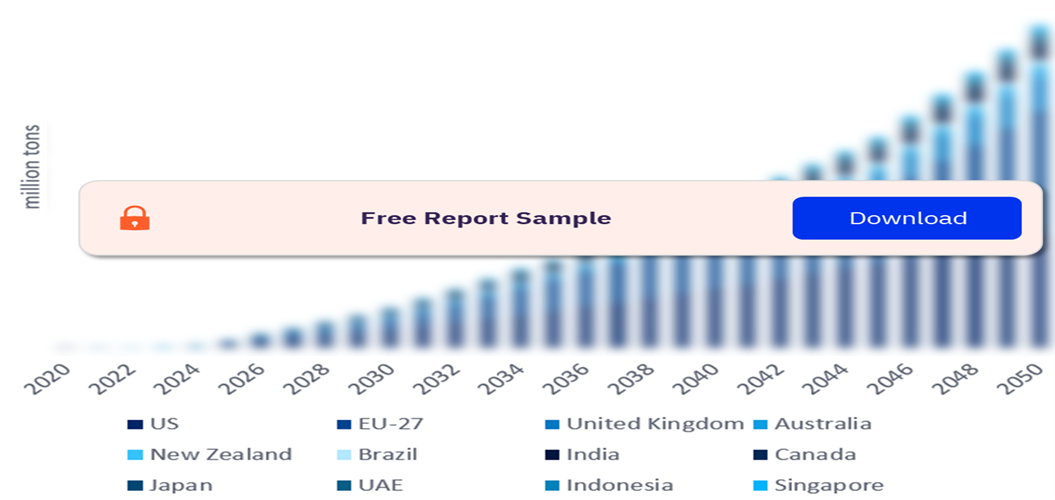
Corporate carbon reduction targets, mounting policy attention, as well as passenger interest in the decarbonization of the aviation industry will drive global SAF demand. APAC’s prospective demand appears far lower when compared to its vast supply, with Australia, New Zealand, India, Japan, Indonesia, and Singapore only set to account for more than 10% of global SAF demand in 2050.
SAF Demand by Country, 2020 – 2050
Buy the Full Report for More Insights on the SAF Supply and Demand Outlook
Download a Free Report Sample
Sustainable Aviation Fuel - Projects
The major projects in the SAF market are Decatur Renewable, Rotterdam Renewable, Singapore Renewable, Maoming Renewable, and Uruguay Renewable, among others. Decatur Renewable will have the highest capacity by 2030. Gevo Inc. owns Decatur Renewable in the US. The project will be active by 2026.
Sustainable Aviation Fuel Market Analysis by Projects, 2030 (%)

Buy the Full Report for More Insights on the Projects in the SAF Market
Download a Free Report Sample
Sustainable Aviation Fuel - Industry Players
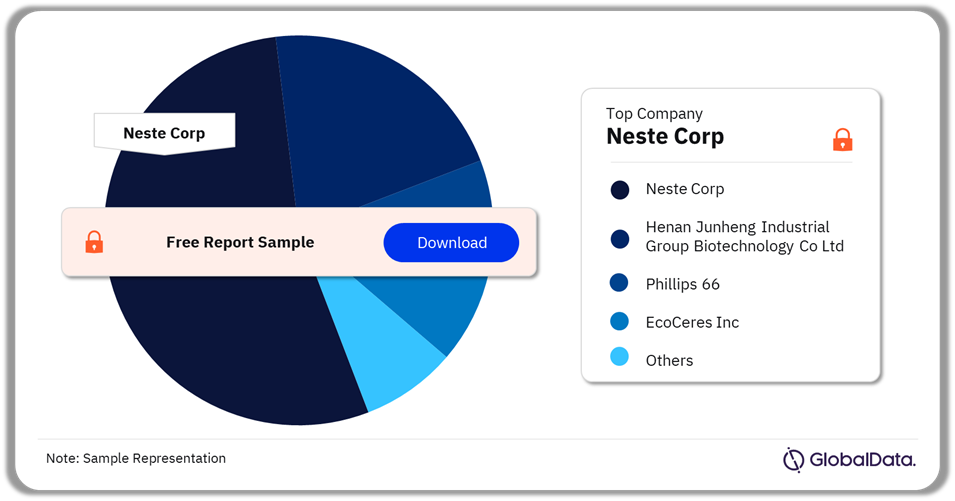
A few of the major players in the SAF industry are Neste Corp, Henan Junheng Industrial Group Biotechnology Co Ltd, Phillips 66, EcoCeres Inc, and Sinopec Zhenhai Refining and Chemical Co., among others. Neste Corp stood first in terms of capacity in 2023.
Sustainable Aviation Fuel Market Analysis by Players, 2023 (%)
Buy the Full Report for More Insights on Players in the SAF Market
Download a Free Report Sample
Scope
The report provides:
- Aviation’s current emissions and emission targets.
- The role SAF will play in decarbonizing the aviation sector.
- Overview of different pathways to produce SAF with particular focus on hydrotreatment and synthetic fuels.
- Overview of countries’ blending mandates or support for SAFs.
- SAF capacity outlook, including upcoming biggest SAF plants by 2030 capacity, and largest producers of SAF.
- Overview of geographical distribution of present and future SAF demand and supply.
- Overview of airlines’ strategies to reduce emissions.
- Overview of signals such as company filings and recent deals as a measure to understand micromovements in the SAF market.
Key Highlights
- Aviation contributes to approximately 10% of all transport-related emissions. Commercial aviation represents a particularly difficult sector to decarbonize, with long-distance journeys and high energy density requirements posing a barrier to energy transition strategies such as electrification, sustainable aviation fuels (SAFs) have been identified as a key technology for achieving emission reductions. More specifically, hydrotreatment and HEFA are currently the dominant pathways to producing SAF, however, due to their limited feedstock availability, other pathways such as PtL (Power to Liquid) will become the prevalent ones in the long term.
- Countries such as the UK, Brazil, Japan, Singapore, South Korea, India, Indonesia, and the EU-27 have already enforced blending mandates.
- Asia, North America, and Europe will be the dominant regions for SAF supply through 2050.
- North America, Europe, and the UK will be the top regions and countries for SAF consumption through 2050.
- Airlines’ strategies currently consist of securing long-term offtake agreements with SAF producers so that they may have sufficient SAF to abide by countries’ blending mandates and meet net-zero targets in the run up to 2050.
Reasons to Buy
- Identify market trends within the aviation industry with regard to decarbonization efforts to meet net-zero targets and abide by countries’ blending mandates for SAF usage.
- Identify key technologies for the decarbonization of the aviation industry, with a particular focus on hydrotreatment and PtL (Power to Liquid).
- Identify which countries have already issued blending mandates, and what other countries are doing to support the development of the technology.
- Identify which countries will become the largest suppliers and consumers of SAFs.
- Develop market insight into what corporations are doing to future-proof their business, including oil and gas companies devoting part of their capacity to SAF production, and airlines signing long-term offtake agreements with SAF producers.
- Stay up to date with the latest deals within the sector, from mergers and acquisitions to venture financing and private equity deals.
Neste Corp
Oriental Energy Co Ltd
Avalon Bioenergy Uruguay SA
Montana Renewables LLC
Azure Sustainable Fuels Corp
World Energy LLC
Summit Next Gen LLC
Henan Junheng Industrial Group
Phillips 66
EcoCeres Inc
Sinopec
Cemvita Factory Inc
Energy Absolute Public Co Ltd
DG Fuels LLC
Air Canada
Air France-KLM
All Nippon Airways
American Airlines
Cathay Airlines
Delta
Ethiad
Emirates
Finnair
Japan Airlines
JetBlue
KLM
Lufthansa
Qantas
Ryanair
Shell Aviation
United Airlines
Virgin Atlantic
Wizz Air
Valero Energy Corp
BP Plc
Eni SpA
Bangchack Corporation Plc
TotalEnergies SE
Repsol SA
Suncor Energy Inc
Esso SAF
Shell Plc
International Airlines Group
Infinium
Table of Contents
Table
Figures
Frequently asked questions
-
How many pathways are certified by IATA for producing SAFs?
There are currently 9 pathways for producing sustainable aviation fuel (SAFs) which are certified by the IATA.
-
Which technology accounts for the bulk of SAF production?
Hydrotreatment currently accounts for the bulk of SAF production.
-
What are the major projects in the SAF market?
The major projects in the SAF market are Decatur Renewable, Rotterdam Renewable, Singapore Renewable, Maoming Renewable, and Uruguay Renewable, among others.
-
What are the top companies in the SAF industry?
A few of the major players in the SAF industry are Neste Corp, Henan Junheng Industrial Group Biotechnology Co Ltd, Phillips 66, EcoCeres Inc, and Sinopec Zhenhai Refining and Chemical Co., among others.
Get in touch to find out about multi-purchase discounts
reportstore@globaldata.com
Tel +44 20 7947 2745
Sample Report
Sustainable Aviation Fuel (SAF) – The Way Forward for the Aviation Industry was curated by the best experts in the industry and we are confident about its unique quality. However, we want you to make the most beneficial decision for your business, so we offer free sample pages to help you:
- Assess the relevance of the report
- Evaluate the quality of the report
- Justify the cost
Download your copy of the sample report and make an informed decision about whether the full report will provide you with the insights and information you need.


