Technology has always transformed how we work and live. They make our lives easier and more efficient, and AR is the next step in that process. While AR is making strides in consumer markets, its potential impact on human performance is even greater in industrial settings. The application of AR can be found in several industries like insurance, healthcare, and foodservice, among others.
As a part of this bundle, you will gain access to in-depth insights available in the following reports:
- Thematic Research: Augmented Reality in Retail and Apparel
- Thematic Research: Augmented Reality in Automotive
- Thematic Research: Augmented Reality in Banking
- Thematic Research: Augmented Reality in Construction
- Thematic Research: Augmented Reality in Consumer Goods
- Thematic Research: Augmented Reality in Defense
- Thematic Research: Augmented Reality in Foodservice
- Thematic Research: Augmented Reality in Healthcare
- Thematic Research: Augmented Reality in Insurance
Report 1- Thematic Research: Augmented Reality in Retail and Apparel
The leading adopters of AR in the retail and apparel industry are technology-focused and is residing primarily in the e-commerce domain. Brands like Zara are launching AR displays to attract more shoppers to their stores. Using the Zara app, a customer can hold their phone up to a sensor and can view models wearing clothes from different Zara ranges and make purchases. M&A activities in the AR market are increasing, with access to technology being one of the primary drivers for most deals. As the industry seeks more engaging and immersive experiences, 3D visualization, collaboration solutions, and hardware providers are prime acquisition targets.
AR Value Chain Analysis
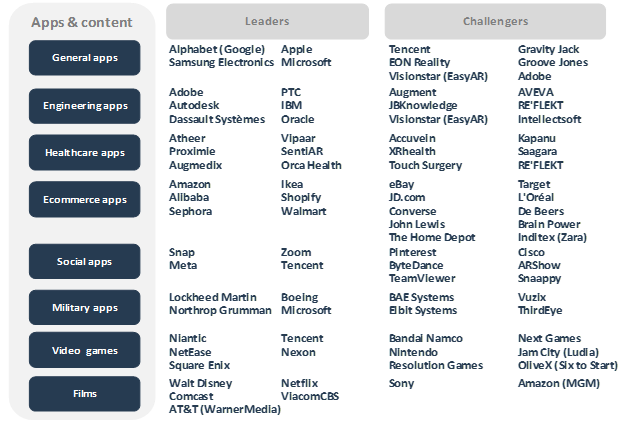
For more insights on AR value chains, download a free report sample
Report 2: Thematic Research: Augmented Reality in Automotive
The augmented reality (AR) market size was valued at $7 billion in 2020 and is expected to achieve a CAGR of more than 35% between 2020-2030. AR can play a variety of useful roles in vehicles. AR enables more precise guidance based on the actual road layout in front of the driver by superimposing navigation instructions on real-world images. Consumers are more concerned about interacting with shared surfaces owing to the COVID-19 pandemic. As a result, the demand for systems that allow users to interact without making physical contact will rise in the coming years. AR is expected to play an important role in the onboarding of information and entertainment systems in autonomous vehicles in the future.
AR Market Analysis by End Users
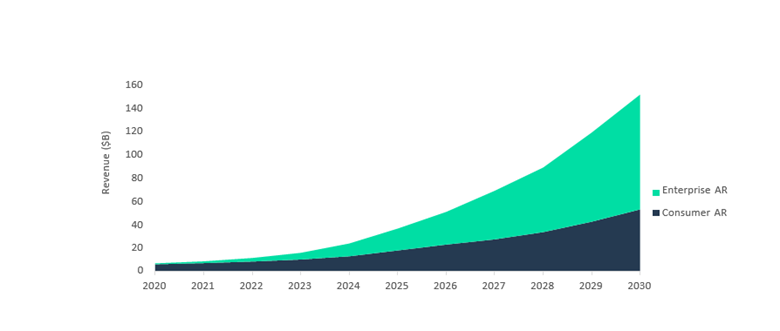
To gain more information about the AR market forecast, download a free report sample
Report 3- Thematic Research: Augmented Reality in Banking
The AR market size was valued at $7 billion in 2020 and is expected to grow at a CAGR of more than 35% during 2020-2030. The leading AR adopters in the banking sector are companies that develop their AR apps and content or those that collaborate with leading AR vendors who specialize in AR platforms and AR hardware. BNP Paribas announced in 2019 that it will introduce an immersive, augmented reality experience initiative that will provide customers with virtual in-person banking. Understanding the technological implications of AR for product and experience design will assure that customer behavior does not change the banking channels’ capabilities in times to come.
AR Market Value Chains
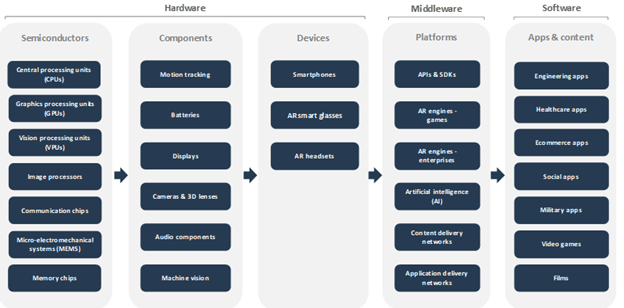
For more value chain analysis in the AR market, download a free report sample
Report 4- Thematic Research: Augmented Reality in Construction
The AR market size was valued at $8.6 billion in 2021 and is expected to achieve a CAGR of more than 37% during 2021-2030. The adoption of AR in construction is in a nascent stage. However, AR use cases are rapidly becoming a reality owing to the increased implementation of precursor technologies such as building information modeling (BIM) and cloud infrastructure. Moreover, AR has the capability to improve construction site safety. Since it is not fully immersive, operatives will be able to view a construction site while using AR to identify potential hazards.
AR Software Revenue Analysis by Type

To gain more information on the AR software market, download a free report sample
Report 5- Thematic Research: Augmented Reality in Consumer Goods
Social distancing measures, as well as health concerns exacerbated by the pandemic, have significantly altered how consumers shop and supply chains operate. These changes have made AR solutions a more valuable investment for consumer firms. These days, consumer firms are using AR packaging to advertise the sustainable credentials of their products. They are also using AR packaging to portray how their products are made. These easily accessible AR experiences can make companies’ supply chains more transparent and highlight how well the product performs in terms of sustainability. Generally, adding AR features like AR packaging and AR try-on solutions to consumer products makes them more ‘digitally smart’.
AR Market Analysis by End Users

For more end user insights into the AR market, download a free report sample
Report 6- Thematic Research: Augmented Reality in Defense
Augmented Reality (AR) is increasingly being used in battlefield applications for pilots and infantry for enhancing a soldier’s situational awareness and reaction times. AR training provides a wider range of simulated environments, circumstances, and variables while also being safer than learning battlefield skills on the battlefield. This reduces the risk of soldiers being injured and expensive military equipment being damaged by trainees. The US has issued most of the tenders in AR in the defense sector over the last three years. Moreover, the UK, Canada, Australia, and India provide tenders in fields like surveillance, operations, engineering, and training.
AR Market Analysis by Platforms
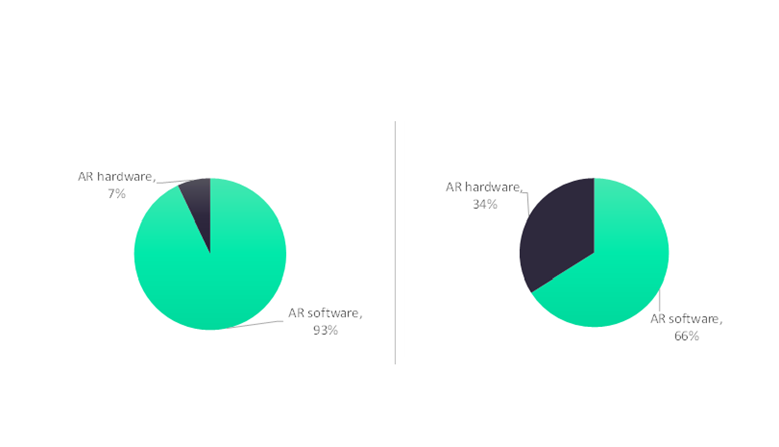
For more platform insights into the AR market, download a free report sample
Report 7- Thematic Research: Augmented Reality in Foodservice
AR will be a significant technology in the future of foodservice work, supporting operational efficiency and increasing productivity. As consumer lifestyles continue to transform digitally, foodservice companies must invest in technologies that raise their company profile and keep up with relevant trends like social media, environmental, social, and governance (ESG), and the metaverse, among others. For example, the foodservice industry can use AR to improve ESG strategies by reducing food waste and cutting carbon footprints. Furthermore, AR-enabled employee food preparation training can aid in reducing food waste by increasing product accuracy.
AR Software Market Analysis by Type

For more type insights into the AR software market, download a free report sample
Report 8- Thematic Research: Augmented Reality in Healthcare
The most promising use cases for AR are in assisting healthcare providers, particularly in surgical assistance and professional training. AR has primarily been used in niche applications within manufacturing, sales, and marketing for pharmaceuticals and medical devices. AR tools can improve the precision and safety of medical procedures by superimposing visualizations on patients’ bodies. Using AR tools, doctors can explain upcoming procedures to patients, which will improve their confidence and compliance. Additionally, by performing AR simulations of chronic conditions like rheumatoid arthritis, migraine, or diabetes, physicians can offer more sympathy to patients alongside identifying potential areas for improvement.
AR Medical Devices Pipeline Products Market Analysis by Equipment Type

For more insights into AR medical devices pipeline products market, download a free report sample
Report 9- Thematic Research: Augmented Reality in Insurance
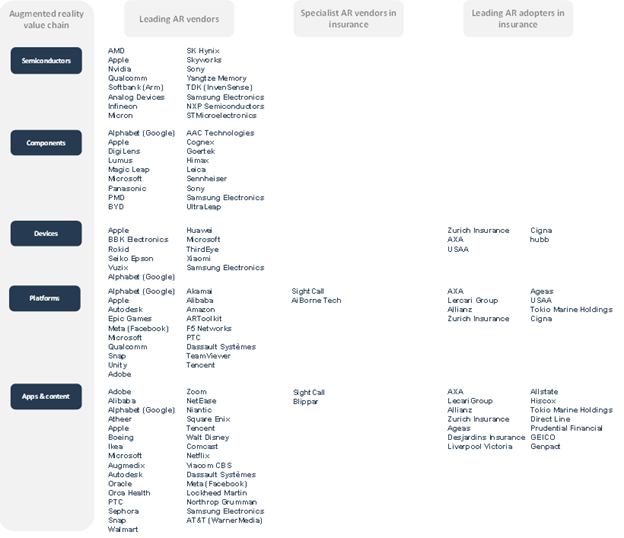
Underwriters can use AR to simulate real-life disasters like flooding and landslides and estimate potential damage. AR can also be used by insurers to decipher insurance plans for customers, simplifying the often-complicated process of understanding and selecting the right plan. Customers’ lack of trust in insurance companies can be mitigated by increased transparency and clarity. Apart from raising risk awareness, insurers are using AR to create entertaining marketing ploys and interactive advertising campaigns that are more likely to engage younger generations than traditional brochures.
Key Players in the AR Value Chain
For more insights into the AR market, download a free report sample