
Summary
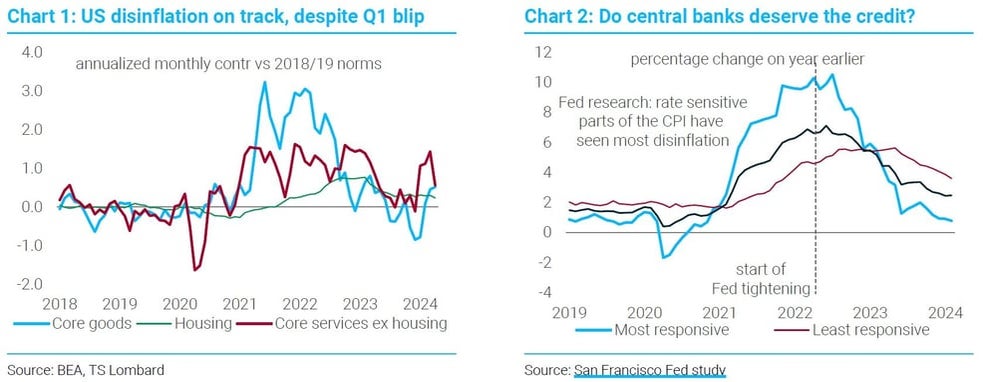
Though most people are unhappy about the state of the global economy, from the perspective of the average central banker, it is not clear how things could have gone any better. Inflation has returned to tolerable levels (even if it is not quite back to those arbitrary 2% targets), there has been no recession (“technical” recessions don’t count) and nothing has broken in the financial system. In fact, the world is adjusting to higher rates better than anyone expected. Given the nightmare situation central banks thought they were facing two years ago, this is a remarkable turnaround. Arguably, it is the finest moment of independent central banking, testimony to their credibility, wisdom, determination, and courage. We are fortunate to have them – at least that is what they tell us. The reality, of course, is that central banks got lucky and are now taking the credit for developments that were either beyond their control or would have happened anyway. Let’s hope the authorities understand this, because there is no guarantee their luck will hold.
Two years ago, the world’s central bankers were facing their worst nightmare. Inflation had broken out to its highest levels in half a century, price pressures were becoming increasingly broad-based, and inflation expectations were starting to drift higher. To the average monetary technocrat, it looked as if the Great Inflation of the 1970s was happening again. And that would have been a disaster. Remember, the whole raison d’être of the modern, independent central bank was to ensure that the so-called “mistakes of the 1970s” were never repeated. As I explained to investors in 2022 – when officials shocked everyone with their aggressiveness – you had to see the situation from the central banker’s perspective. Powell, Bailey, Lagarde and co. did not want to go down in history as a case study in monetary failure. The economics profession had spent decades studying what went wrong half a century ago, but at least the policymakers of the 1970s had not had a template for what might happen. Until then, we had never seen wage-price spirals or a persistent inflation outbreak (because inflation had essentially been white noise during the Gold Standard). Allowing those dynamics to happen again would have been totally unforgivable. If history had treated Arthur Burns badly, imagine how it would treat the likes of Jay Powell?
What followed was a monumental exercise in technocratic “base-covering”. (That’s the polite term for what you wrote, Dario – ed.) Central banks raised interest rates at a breath-taking pace, to levels that had seemed unimaginable just 12 months earlier. Officials thought these actions might crush their economies, but they did not care. The “whatever it takes” monetary philosophy that had defined central banks’ interactions with financial markets in the decade before the pandemic became “whatever it breaks”, with central banks displaying a steely determination that seemed alien to investors who had learned their craft during the era of ZIRP, NIRP and perma-QE. But today the authorities have somehow got away with their monetary radicalism. In fact, it is not clear how things could have gone any better. Inflation is back to tolerable levels (though not quite 2%), there has been no recession – despite every market pundit saying a recession was “inevitable” 18 months ago – and nothing has broken in the financial sector (the odd scare notwithstanding). Sure, the price level is 20+% higher than it was in 2019, which has irritated everyone; but from the central banks’ perspective, the situation today must be an enormous relief.
So how did we end up in this position? The authorities – and their cheerleaders in academia and in thinktanks – want us to believe that recent developments are testimony to the importance of independent central banks. It was their “credibility” that delivered lower inflation without a recession. Their decisive actions kept the expectations fairies on side, which anchored inflation at low levels. Without the aggressive policy response and the “credibility dividend” central banks had built up over decades of monetary success, we could easily have slipped back into the wage-price spirals of the 1970s. At least, that is their story, and they are sticking to it: “inflation is always and everywhere a monetary phenomenon”. In reality, of course, there are massive holes in that thesis. For a start, I don’t think we were ever in danger of “repeating the 1970s”. The world today looks structurally very different, and 40 years of neoliberalism cannot be reversed with a one-off fiscal stimulus, however large. Inflation is not just about money; it is about power. And workers today were never going to have enough power to generate a persistent wage-price spiral. But it is not just the fake 1970s counterfactual that is problematic with the “aren’t we lucky to have credible central banks” thesis. It is important to acknowledge that the authorities are taking credit for some disinflationary dynamics they were never in control of.
To redress the balance and provide a counterargument to the “official” narrative (not to mention the inevitable flurry of CB research papers), I can think of at least three ways the authorities have been lucky or are taking credit for things that would have happened anyway:
1. Price level shock: The combination of large (but ultimately one-off) fiscal stimulus, pent-up demand (revenge spending) and severe supply chaos always looked like a shock to the price level, not a permanent increase in the rate of inflation. It started in goods, spread to services, and is now passing through popular “supercore” metrics (where components such as insurance premiums are playing an outsized role). Officials say we are in the “difficult last mile” to 2%inflation, but actually these are just the ”last lags” in the price-level adjustment. Central banks panicked because inflation was looking so broad-based in 2022, but breadth wasn’t a sign that expectations were “unanchored” or that inflation psychology had changed. The closest historical parallel was always with the 1940s, not the 1970s. Post-WW2 inflation resolved itself even without a large monetary response (hiking rates would have been “unpatriotic”).
2. Help from supply: It was not just supply chains that normalized after COVID-19. There was also a big supply response in labour markets. Remember, back in 2022, central banks claimed there was a fundamental imbalance in labour markets that needed to be corrected by reducing demand. And monetary policy probably helped at the margins, encouraging companies to close unfilled vacancies, which discouraged labour-market turnover and dampened wages. Yet, many of the job openings that disappeared after COVID were in sectors that had been distorted by the pandemic. Demand for workers in those sectors would have declined anyway. And labour supply recovered. Participation rates bounced, while the economies that had seen the most serious staff shortages also allowed an unprecedented wave of immigration. Job vacancies were converted in jobs, which kept employment and GDP growing. A big part of this rebalancing had nothing to do with monetary policy.
3. Reduced monetary squeeze: The impact of monetary tightening has been much lower than most people (including central bankers) expected two years ago. The reason for this is simple: debt-servicing ratios have stayed low, thanks to a combination of debtors (both household and corporate) terming out their loans and rapid growth in nominal incomes. That is not to say that monetary policy had no impact. Some parts of the monetary transmission mechanism have been working nominally. Higher interest rates certainly reduced the demand for credit and encouraged saving, which curbed housing demand and construction activity. We saw these so-called “substitution effects” in operation cross the DM world. But as long as debt-servicing ratios stayed low, we were never going to see the sort of financial distress that had accompanied previous episodes of financial distress, particularly in the early 2000s (back then, a much larger proportion of homeowners had variable-rate mortgages and private credit had been growing rapidly for many years).
Central banks got lucky. The question now is whether they are going to take the win and secure what, to many pundits, seemed an impossible soft landing two years ago. But not all central banks are in the same position. While the three forces above are true in general, there is significant variation across countries. Monetary tightening has obviously had a bigger impact in countries with higher debt levels or whether the pivot to longer-term fixed-rate borrowing has been less extreme. The US, for example, looks in a much better position than Canada, New Zealand, Australia, the UK, the Nordic countries and some parts of the euro area. The central banks of those countries always seemed more vulnerable to “overtightening”, and may still need to pivot quickly in order to secure the soft landing. These are my monetary canaries, and some of them look as if they might be about to croak (if canaries do indeed “croak”). Should the authorities not pivot, existing debts will continue to roll over at higher interest rates, which means the squeeze from monetary policy will only grow over time. While this dynamic is less troubling in the US, there are some areas – like CRE and SME fundings – which will need careful monitoring.
The real stroke of luck, however, could be in how economies evolve over the next few years. If central banks can secure the soft landing, they could find themselves in a macro environment that looks decidedly more favourable that what we had before COVID-19. This is basically the “high-pressure” regime policymakers dreamed of in the 2010s, particularly in Europe, where central banks spent a decade battling the onset of Japanese-style deflation, messing around with useless monetary instruments like QE and negative interest rates. Some pundits can’t see this opportunity: they look at today’s labour markets and say they are not that different from what we had in 2019. But it is important to remember that it took a decade of mediocre growth to get to the situation we had just before COVID-19. A soft landing now would lock in those conditions and put us in a new business cycle that’s starts on a much firmer footing than the post-GFC expansion. Economies would be closer to full employment, and gentle reflation would replace persistent lukewarm demand. Our research has shown that high-pressure labour markets can bring important benefits, including increased investment, higher participation, faster productivity, stronger wages and even reduced inequality. This new regime did not happen by design, and it does not depend on policymakers being particularly competent. We have stumbled on this economy by accident. Let’s hope the authorities don’t stand in the way, and just allow these dynamics play out. Who knows – maybe central banks can eventually take the credit for this too.
For more from Dario please request a trial to our research, (certified investment professionals only, please)


