BEV sales in Southeast Asia surge 89% in Jan-Sept
BEV sales account for 21% of regional sales in the nine-month period, led by Vietnam.
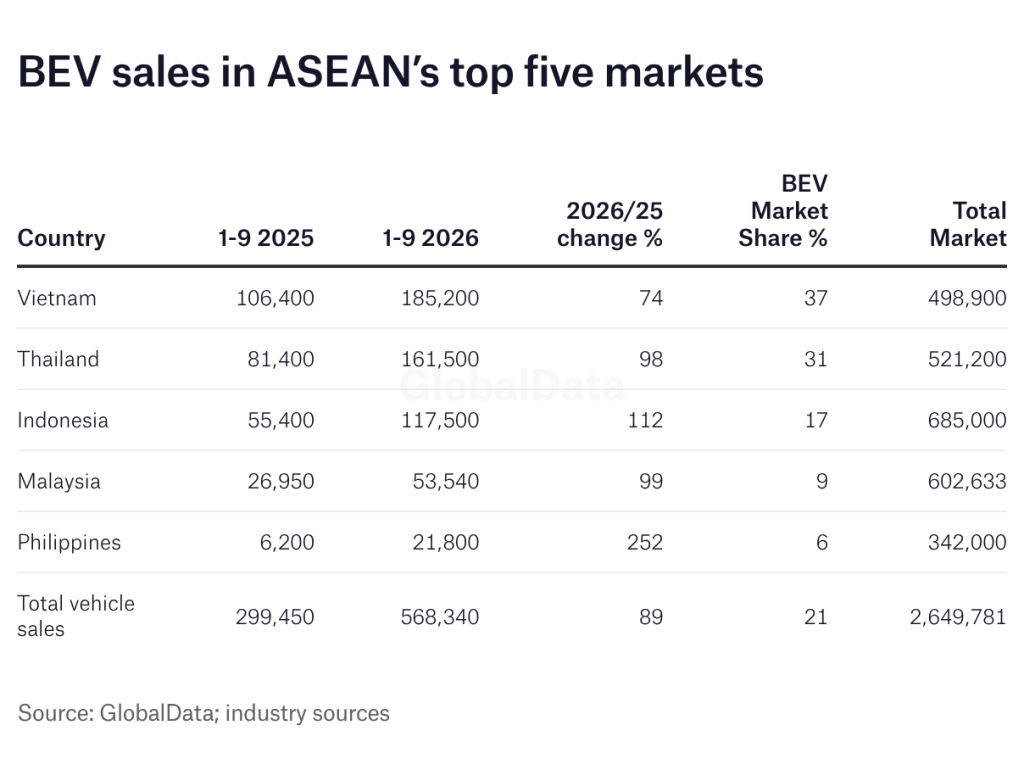
Sales of battery electric vehicles (BEVs) in Southeast Asia’s five main markets, including Indonesia, Malaysia, Thailand, Vietnam and the Philippines, are estimated to have risen by 89% to 567,340 units in the first nine months of 2026, up from just under 300,000 units in the same period last year.
Demand has been driven by favourable government policies, including preferential excise/sales tax rates and investment incentives, while this year’s surge in fuel prices has also encouraged buyers to switch to fuel-efficient electrified vehicles, including BEVs. Charging infrastructure has also improved significantly across the region in the last year, including the availability of fast-charging systems, while EV batteries have also improved significantly, offering longer driving ranges.
Chinese brands dominate the region’s BEV segment along with Vietnamese automaker VinFast, while European brands such as BMW and Mercedes-Benz have a marginal presence and Japanese are virtually non-existent in this segment.
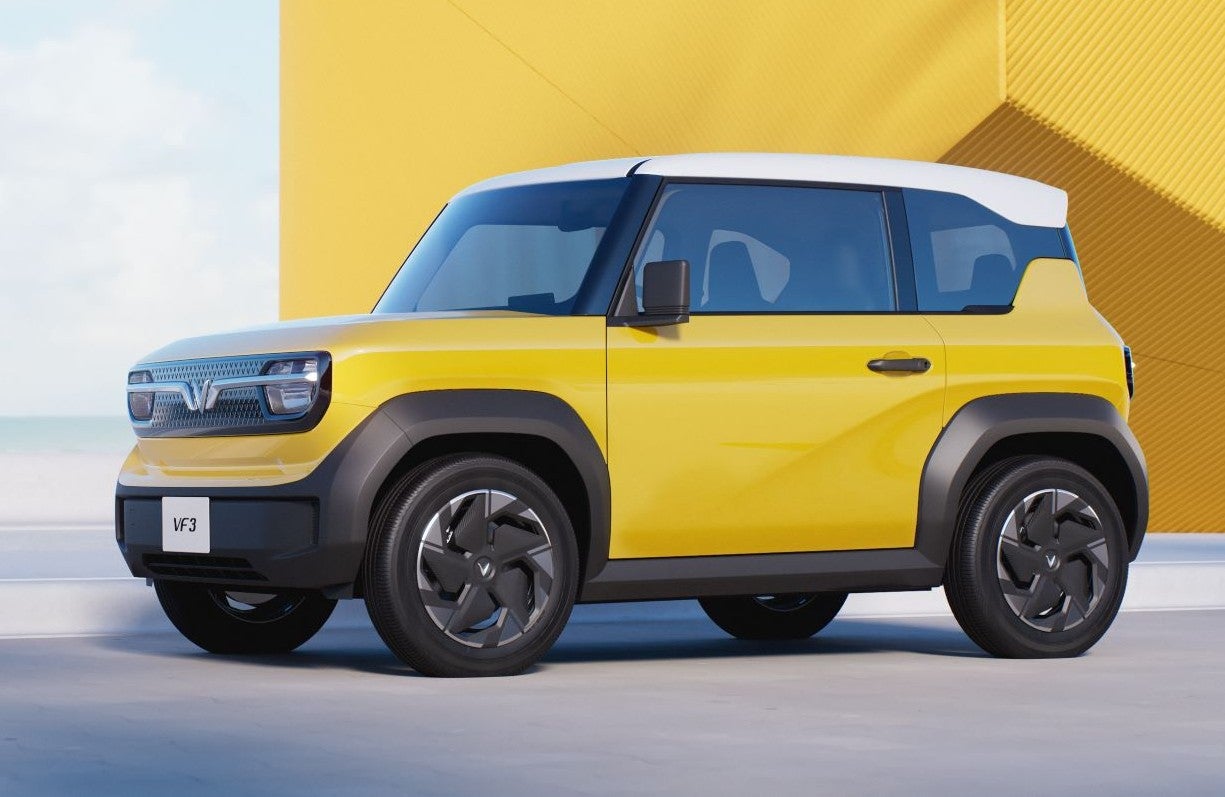
Vietnam is the region’s largest single market for BEVs after Vietnam, with an estimated 185,000 sales in the first nine months of 2026, up by 74% year-on-year and accounting for 37% of total vehicle sales in the country. More than 96% of these sales were accounted for by domestic automaker VinFast Auto, which completed its switch away from internal combustion engine (ICE) vehicles back in 2022. The company sold around 177,700 light passenger BEVs domestically in this period, along with an estimated 600 or so battery-powered buses.
Local manufacturer Kim Long is also expanding rapidly in the battery-powered commercial vehicle segment, albeit from low levels. Chinese automakers such as BYD, Wuling SAIC-MG, Geely and Chery-Omoda are also increasingly targeting this segment, so far mainly with imports. The Vietnamese government recently extended its current registration tax exemption programme for BEVs until 2030, along with consumption tax discounts.
Thailand was the region’s second-largest BEV market in the region after sales almost doubled to 161,500 units in the first nine months of the year, accounting for 31% of total vehicle sales in the country. The segment is overwhelmingly dominated by Chinese brands, with a mixture of locally assembled and imported vehicles, supported by preferential taxes and generous government incentives aimed at attracting inward investment.
BYD and its Denza sub-brand lead the segment with sales estimated to have exceeded 28,000 units year-to-date, comprising mainly the Dolphin, Atto and Sealion model lines, followed by Chery Automobile with around 27,000 units, including its Omoda and Jaecco brands, as well as SAIC-MG, Geely and GAC-Aion.
Recent reports have suggested that the Thai government plans to hike the excise tax on imported BEVs at the beginning of 2027 to at least 30%, pushing manufacturers to step up localization efforts, including local assembly and supply chain development. The increased tax is expected to prompt buyers to rush into the market in the final months of 2026, likely negatively affecting overall BEV sales next year.
Indonesia is Southeast Asia’s third-largest BEV market, with sales surging by 112% to 117,500 units in the first nine months of 2026, accounting for 17% of total vehicle sales, up from 10% last year and just 4% in 2024. Sales have been driven by preferential taxes such as import duty and registration tax exemptions, while manufacturers are offered investment and local content incentives.
At the beginning of 2026, the government discontinued its automatic BEV import duty exemption, replacing it with a 1:1 local production quota until the end of 2027 to encourage local production, while also discontinuing the luxury tax exemption. The sales tax exemption for locally-produced BEVs, linked to minimum local content requirements, is still available but is now handled at regional level, while the luxury tax exemption has also been retained.
Indonesia’s BEV segment is dominated by Chinese brands, led by BYD and its Denza brand with over 41,000 sales combined year-to-date, followed by Chery and its Omoda and Jaecco brands with over 30,000 units. The Jaecco J5 is Indonesia’s best-selling BEV model with almost 27,000 sales so far this year. Wuling sold almost 11,000 BEVs in the nine-month period, followed by GAC Aion with around 5,500 units.
BEV sales in Malaysia almost doubled to 53,540 units in the first nine months of 2026, accounting for 9% of total vehicle sales in the country. The government offers preferential taxes and incentives for locally-assembled BEVs, including full import duty, excise and sales tax exemptions until the end of 2027, while restrictions on built-up imports have been increased. The market is led by Proton with its e,MAS sub-brand, with sales of the Geely-based models amounting to 24,860 units year-to-date. BYD-Denza sold 8,500 units, followed by Chery with 3,900 units.
The Philippines is the smallest BEV market among the five countries, albeit with sales surging by 254% to an estimated 21,800 units in the first nine months of the year. Growth has been driven by favourable government policies, including an import duty exemption until 2028 and tax incentives for local production. The market is led by BYD, with almost 6,000 sales year-to-date, followed by VinFast with 5,500 units and Tesla with 3,500 units.