Why the Robotaxi rulebook will shape the future of private-car autonomy
Key insights from The SAE Automated Transportation Symposium 2026

The 2026 SAE Automated Transportation Symposium (ATS) took place in San Diego on July 27–30, drawing OEMs, suppliers, transportation agencies, and regulators together around the task of moving higher automation solutions (SAE Level 3–5) from pilots toward scale. GlobalData's central finding from the four-day event is that the technology is moving faster than both the regulatory frameworks and the consumer understanding needed to carry its broader adoption.
This is why a private vehicle forecast should watch Robotaxis. While the Stuttgart Autonomous Vehicle Tech Expo earlier this year made the case for enhanced Level 2, ATS sits at the other end of the spectrum looking at driverless L4 fleets and the machinery to certify them. Capability is no longer the main gateway, replaced instead by liability, regulation, and consumer trust, and each of those is being resolved first in fleet deployments.
From pilots to scale: the L4 story on show
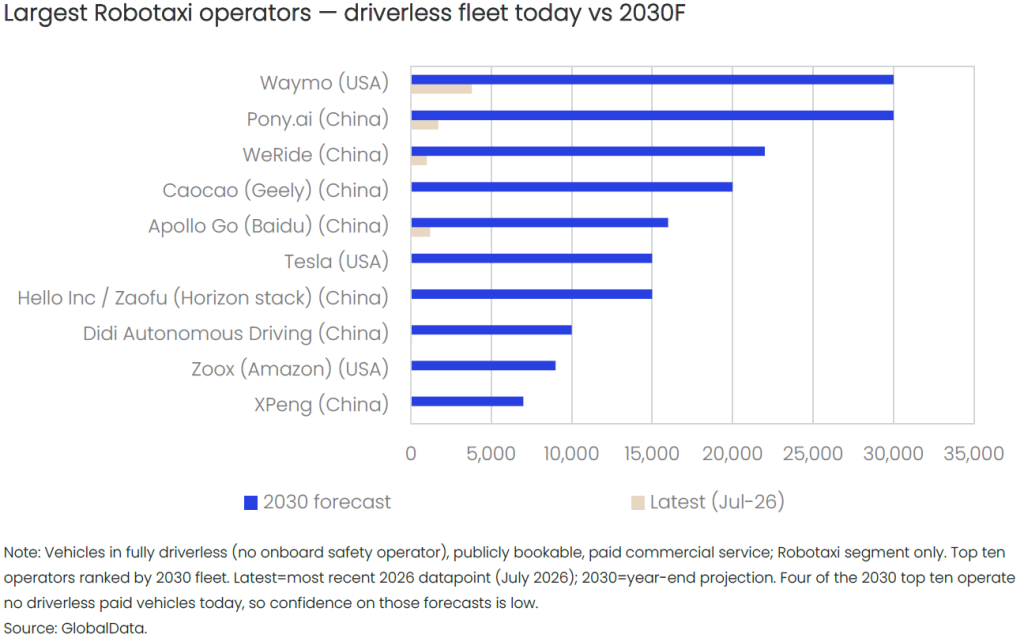
Fleet numbers have now grown beyond the point of dismissal. In the US, Waymo currently operates roughly 3.5–4k vehicles across 11 US metropolitan areas and delivers around 500k paid rides a week.[1] Zoox, which sits earlier on the adoption curve, said on Day 3 of the conference that it expects its fleet to reach the thousands early next year.[2] Meanwhile, in China, Pony.ai runs a fully driverless fleet across the country’s four tier-1 cities, drawing from a smaller global base of 1.7k vehicles as of late May.[3] The industry’s language has also seen a shift, with Robotaxi operators now talking in terms of miles between "stuck" events and vehicles per remote operator, which demonstrates a focus on running a business rather than proving the technology.
Public agencies trying to keep up with this growth are improvising, and candid about it. A Day 3 panel with Department of Transportation (DOT) representatives from Los Angeles, Austin, Michigan, and Minnesota described enforcement tactics invented in real time. California has moved fastest: since July 1, its police can issue "notices of noncompliance" to Autonomous Vehicle (AV) manufacturers, and emergency response officials can issue an "emergency geofencing message" that requires an operator to steer its fleet out of a designated area—a lever the Los Angeles panelist described using during the recent FIFA World Cup. Where no clean channel exists, first responders still resort to improvised methods like hitting the hood of a Robotaxi to make it stop, which is why SAE's J0911, a standard governing first responder interaction with fleet-managed, Automated Driving System (ADS)-dedicated vehicles that is now in its final stretch, matters.
The real story for private cars: regulation trickles down
Improvisation works in a fleet model because someone plainly owns the failure, which is why fully driverless vehicles will scale first with Robotaxis. In a privately owned vehicle, ownership fragments. For example, as one transportation-law session laid out, a single incident can pull four parties into the claim at once, spreading responsibility across the OEM, the ADS developer, the owner-operator, and the map and sensor-data companies behind the vehicle. A delegate poll in the fleet-versus-private AVs workshop captured the mood, with the majority expecting fleet or shared vehicles to dominate Level 4 travel. The share of respondents selecting that option rose from 36% to 58% over the course of that single session.[4]
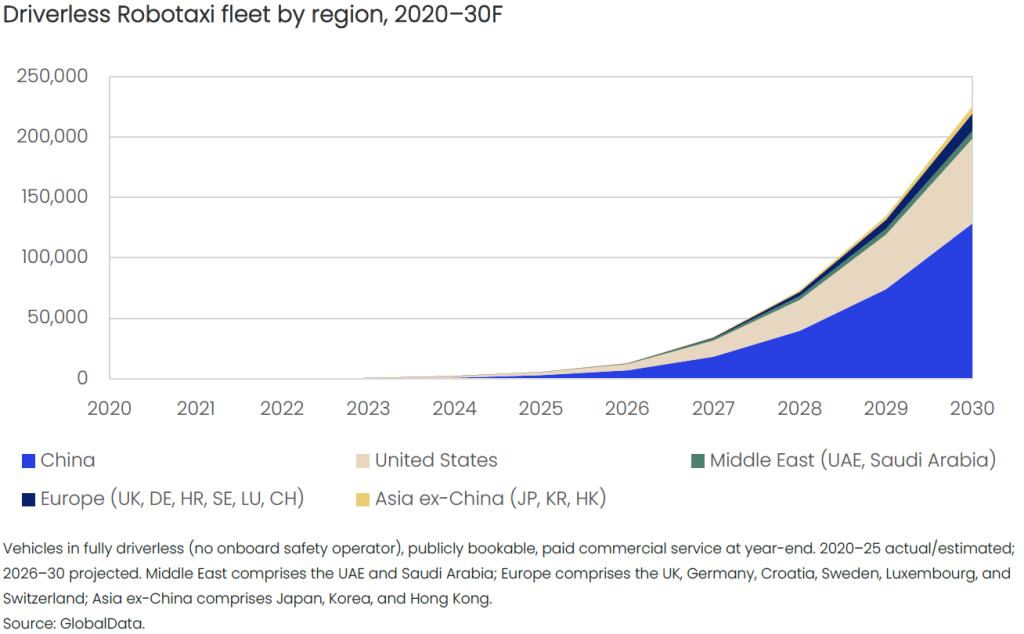
Regulation itself moves slowly and unevenly. In the US, no new federal AV law has reached the statute book this year—the SELF DRIVE Act cleared committee by a single vote, and a Commercial Vehicle framework just recently passed the House of Representatives—leaving a state-by-state patchwork in which the private sector sets the pace. Globally, other regions take different approaches. In Europe, the path to driverless vehicles is driven by legislation first, which has led to the slower adoption of Robotaxi fleets. China sits between the two, with cities rather than the central government setting the rules, such as permitting how many vehicles may operate and drawing the pilot zones, so each deployment advances as a city-level legal experiment. Federal movement did surface in the Day 4 National Highway Traffic Safety Administration (NHTSA) keynote from Jonathan Morrison. On July 30, NHTSA granted Zoox an exemption to run up to 2.5k vehicles a year and charge for rides in Las Vegas[5], proof that AV operators can validate safety without meeting every legacy standard. His priority that matters most for private vehicles is stripping out rules that assume a human is driving including: FMVSS 135[6], the Light Vehicle (LV) brake standard, rewritten around braking distance rather than a brake pedal; FMVSS 101, which covers controls, telltales, and indicators, stripped of dashboard warnings a machine does not need; and a new deployment consortium, Advancing America's Safety and Competitiveness for the Evolution of National Deployments (ASCEND).
The consumer problem: naming, handover, and trust
Evidence persuades regulators, not owners. Panelists were blunt, stating that owners do not grasp the difference between L2, L2+, and L3, that marketing names shape expectations more than SAE levels do, and that inconsistent naming erodes trust. The distinction is not academic: at L2 the human is responsible, while at L3 the ADS developer owns the dynamic driving task, and nobody has cleanly settled who holds it during the handover itself. California requires explicit approval before an L3 system can be deployed and its Department of Motor Vehicles (DMV) now requires an end-user education program while most states still write their traffic law around a human doing the driving. Data suggests that demand is moving in the right direction, but full public confidence remains distant, and panelists noted that consumers reach for comfort before safety, so a system that does not feel comfortable will never be trusted as safe, however good its statistics.
Handover is where that gap in confidence manifests into a tangible issue. Research on Day 1 put the average time it takes for a distracted driver to resume control of the vehicle at around 17 seconds—an age at highway speed.[7] Mercedes-Benz's Drive Pilot allows a 10-second window before it begins an emergency stop, braking to a standstill in lane with hazards lit and the doors unlocked for first responders.[8] That makes the driver-monitoring system (DMS) and human-machine interface part of the safety case rather than comfort features. Panelists described the DMS as the component that decides how much fallback a given driver needs, and research is now under way to estimate a driver's state and likely re-engagement time pushing designs toward phased, context-aware handover rather than a single alarm. The quieter risk is what owners infer when nobody tells them. Left to themselves, they write their own user manual for what the system can do, and the one in the glovebox does not correct it. The conclusion is therefore narrow: private L3 and L4 will arrive first in constrained operational design domains (ODDs) such as highway driving, which puts the burden on the OEM to signal unmistakably when the system is in control and when it is not.
Conclusion: the leading edge sets the rules
GlobalData forecasts that liability frameworks, standards rewrites, and consumer trust will set the pace of L3 and L4 adoption more than technology will. In the US, NHTSA's turn toward exemptions and human-driver-agnostic standards could unlock confident L3 launches sooner than a wait-for-perfect-rules view suggests, while unresolved liability and soft confidence keep private volumes modest in the near term, bound by ODD. As such, growth will likely remain strongest in fleets and supervised L2/L2++.
Full private-car autonomy at scale is therefore some way off, and the reasons have little to do with sensors or computing; they concern who carries the risk and whether drivers understand what they have bought. The frameworks that will govern private L3 and L4 are being written now in the fleet world, where liability is clear and the data richest, and NHTSA's Zoox exemption is the first hard evidence of that machinery moving. The OEMs that will win will need to read the fleet rulebook early, design for narrow, well-communicated ODDs, and treat plain naming and in-car education as part of the product.
Sources: SAE Automated Transportation Symposium 2026 (San Diego, July 27–30); author's session notes and photographed slides; NHTSA keynote (Jonathan Morrison, July 30, 2026); AAA public-perception data; Scanlon et al. (2026); UNECE WP.29 ADS framework; GlobalData Robotaxi and LV forecasting.
Trevor Herrinton, Analyst, Autonomous Vehicles, GlobalData
[1] Waymo fleet size is an estimate: July 2026 industry trackers put the in-service fleet at roughly 3.5–4k vehicles across 11 US metros, with Waymo publicly confirming approximately 500k paid rides per week. Waymo does not publish a city-by-city vehicle count.
[2] Zoox fireside chat with Jesse Levinson, SAE ATS 2026, Day 3 (July 29, 2026); author's session notes.
[3] Pony.ai Q1 2026 results, May 26, 2026: global Robotaxi fleet exceeded 1.7k vehicles as of May 24, 2026; Year-end 2026 target raised to over 3.5k vehicles across more than 20 cities.
[4] Delegate poll conducted during the fleet-versus-private AVs workshop, SAE ATS 2026, Day 1 (July 27, 2026); author's session notes. Unpublished, non-representative sample of attendees.
[5] NHTSA exemption granted to Zoox, July 30, 2026, permitting up to 2,500 vehicles annually for two years; announced in the Day 4 keynote by NHTSA Administrator Jonathan Morrison.
[6] FMVSS: Federal Motor Vehicle Safety Standards, the vehicle safety rules issued and enforced by NHTSA. FMVSS 135 sets light-vehicle brake system performance requirements; FMVSS 101 governs the location, identification, and illumination of controls, telltales, and indicators.
[7] Human-factors research presented at SAE ATS 2026, Day 1 (July 27, 2026); author's session notes. Reported as an average takeover time; simulator-based takeover studies span a wide range depending on task, warning modality, and driver state.
[8] Mercedes-Benz DRIVE PILOT product documentation: if the user does not respond to a takeover request within the maximum allotted ten seconds, the vehicle brakes to a standstill in lane, activates hazard lights, engages the parking brake, triggers the emergency call system, and unlocks the doors for emergency personnel.